

František Vláčil | 2hr 42min
This review was requested by Ravshan, who shared the following thoughts:
“I always thought Marketa stood out from the rest of the Czech new wave, I didnt find much absurdist humour in it but similarly to Andrei Rublev its a film on a transitional period, and I think it’s just a gorgeous film, its sprawling and dense, the composition is stunning, humanity sprawled across long planes of nature, its foreground and background usage, its geometrically sound, and it captures such a dark and epic story, I think this is where the Czech new wave stood strongest.”

The Kozlík clan is not descended solely from the line of men, its matriarch Kateřina whispers to her youngest son one night. Their ancestor Straba possessed the spirit of a wolf, and after savagely killing his bride, was exiled from the village to wander alone. “He carries punishment within himself,” the townsfolk reasoned, as life in solitude is torture enough for such a feral creature, condemned to roam without a pack.
This pagan legend underlies much of František Vláčil’s mythology in Marketa Lazarová, particularly informing its rich character archetypes. Through parallel editing and Kateřina’s cautionary voiceover, it is indelibly imprinted upon the story of Mikoláš, the Kozlík clan’s second-born son. Having just returned from pillaging the neighbouring settlement of clan leader Lazar, he now hungrily regards his captive Marketa, who suspiciously eyes him off in return. Mikoláš approaches, and she runs from his advances, yet neither can escape the Kozlíks’ inherited brutality. At the moment that Straba tries and fails to end his life in Kateřina’s tale, Mikoláš throws Marketa to the ground, and begins to rape her. “Men do not know it. Their pride is met with eternal punishment,” Kateřina declares.
“Straba is of their line.”


Although the Christianity of 13th century Bohemia encroaches upon this primitive pagan order in Marketa Lazarová, Vláčil does not grant moral authority to any organised religion. As the head of the King’s royal regiment, Captain Pivo leads the holy charge against the clan that kidnapped their kinsman Kristian, who is destined to become the future Bishop of Hennau. Where the Kozlík clan’s violence is instinctual, the army’s is rigid and calculated, weaponising its faith against those who diverge from its doctrine.
Quite remarkably, this duality is formally inscribed within Zdeněk Liška’s music score as well, fracturing along sacred-profane lines. Where toneless, breathy chanting and primitive percussion seem to emerge from an ancient past, suggesting pagan ritual, motifs derived from Gregorian chants impose a hierarchal spiritual order. Meanwhile, jagged modernist rhythms encompass the tension between both, matching their vigorous, forceful collision.


After all, this is the ideological war at the heart of Christianity’s European expansion through the High Middle Ages, as well as Marketa Lazarová’s mythopoetic interpretation of it. Although Vláčil adapts his film from a 1931 Czech novel, its episodic construction retains an archaic tone, splitting the film into two parts that reflect its theological division – “Straba” and “The Lamb of God.” From there, Marketa Lazarová announces chapters through cryptic passages that foreshadow key plot points, yet which it admits are “cobbled together almost at random.” Truthfully, this bardic prose does little to clarify Vláčil’s relatively obscure narrative. History cannot be so conveniently summarised into bullet points, but rather unfolds as an accumulation of competing perspectives, many of which cannot be taken at face value in Marketa Lazarová.

As such, the dreamlike, mythic abstraction of Vláčil’s historical fiction takes on a subjective immediacy here, often peering through the eyes of characters as they experience visions of heavenly radiance and hallucinatory dread. The Andrei Tarkovsky influence is readily apparent in its echoes of Andrei Rublev’s medieval spirituality, though on an even broader level, the tactile, elemental realism and formal experimentation reach across many decades of Soviet cinema.
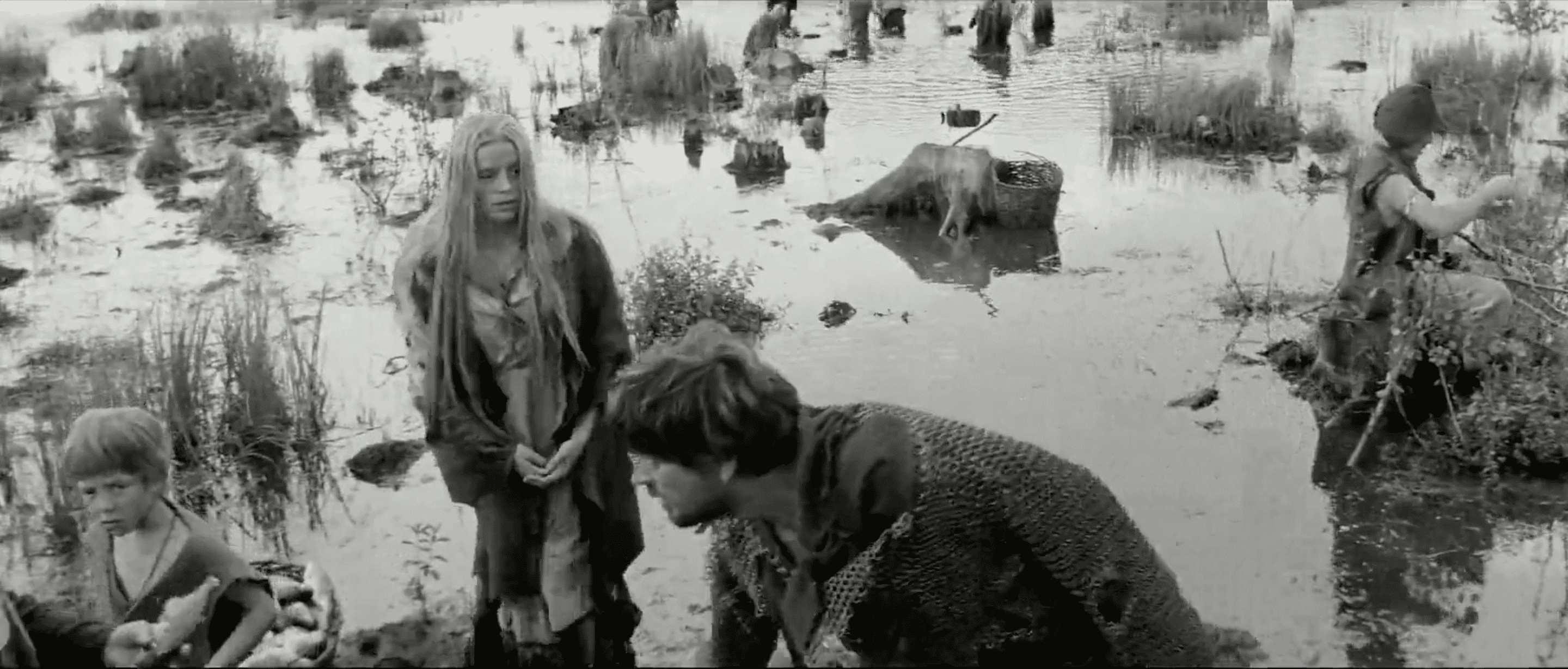

The stark, minimalist geometry of Sergei Eisenstein’s late historical epics reverberates in Vláčil’s battle scenes, particularly recalling Alexander Nevsky’s low angles of warriors against grey skies, while misty, frozen landscapes evoke the primal textures of Mikhail Kalatozov. Nature is at once both beautiful and daunting through this lens, tracing patterns among waving reeds and withering trees, while bodies clad in animal hide make dark imprints against snowy terrains. The onset of Part 2 sees winter’s bitter severity melt away, yet the traces of Sergei Parajanov thus far inscribed in the camera’s fluidity persist through the muddy mire of spring, shaking in jittery handheld motions and point-of-view shots that reject stable, spatial logic.


Among the twisted trees of Bohemia’s forests, Vláčil’s blocking forms particularly arresting tableaux, fusing the Kozlík clan with nature itself as branches seem to protrude from heads and bodies splay out among tangled roots. Quite crucially, these images also diverge from the high arches and geometric columns of the local convent, where bodies are disciplined into rigid symmetry and reverential stillness. Regardless of environment though, Marketa Lazarová makes sharp use of its wide aspect ratio and deep focus across meticulously composed long shots, frequently submitting characters to imposing, monolithic structures whenever they’re not dissolving into nature.
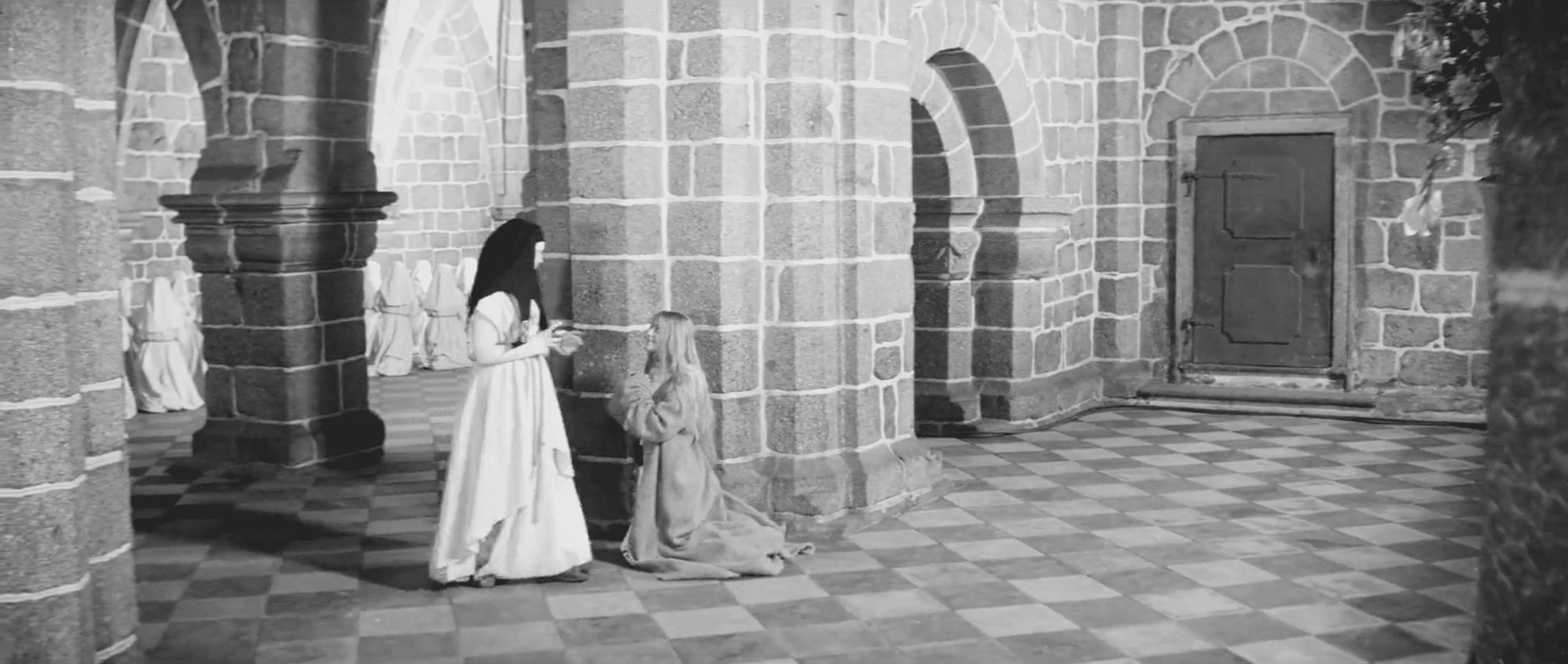


When it comes to framing characters as introspective subjects of a chaotic world however, Vláčil turns toward the psychological cinema of Sweden, resonating Ingmar Bergman’s influence in his off-kilter close-ups. The camera is entranced by naked body parts, sensually framed within intimate compositions and drawing characters down to their corporeal essence. When faces aren’t positioned centre-frame, open expressively to the camera, Vláčil will often tilt them away – though his most breathtaking photography is reserved for Marketa herself.

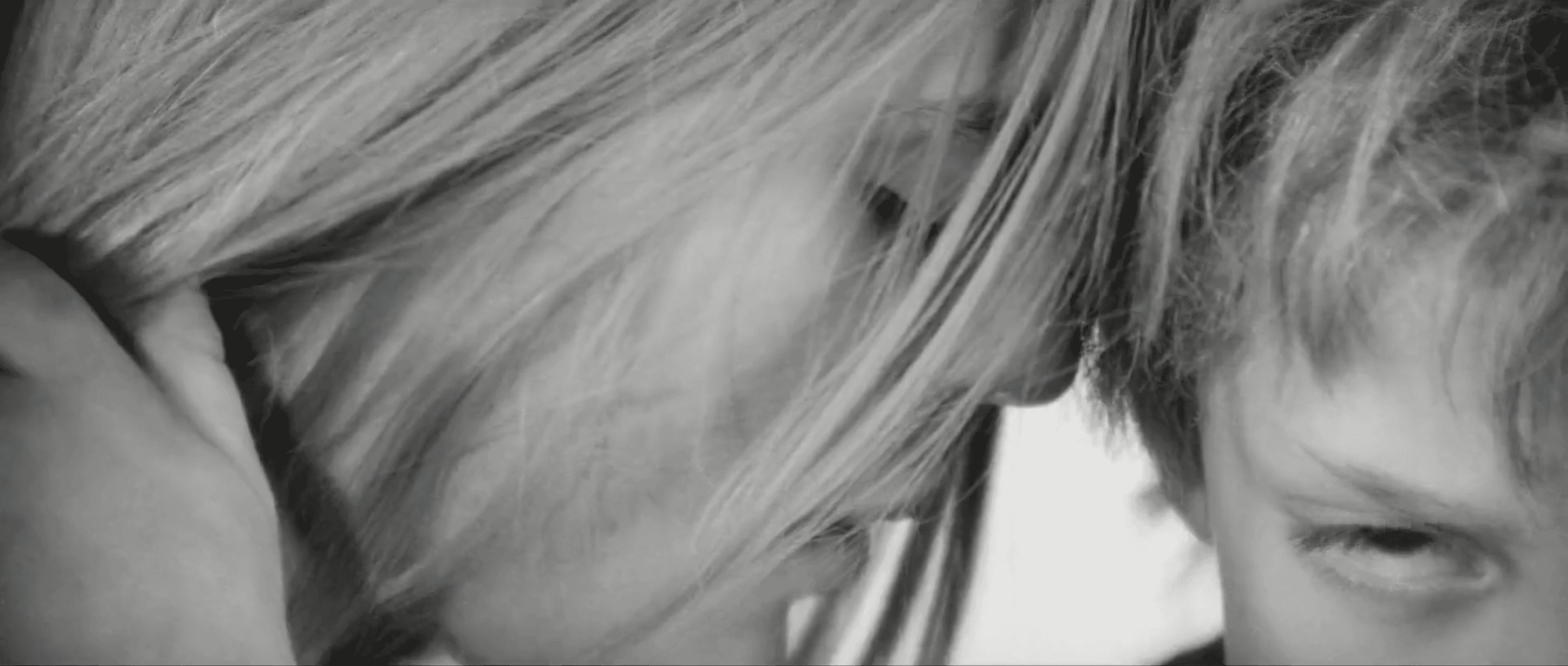
Indeed, this virginal beauty is the symbolic heart of the story, representing perhaps the only pure being in a tarnished world. Her blonde hair matches the immaculate white snow around her, and often falls across her face like a veil, as though adrift in ethereal currents. Next to her, the Kozlík daughter Alexandra appears especially earthbound, her dark hair often mixed with mud and sweat – yet Vláčil does not discriminate so cleanly in this duality. Chained to a hill with Mikoláš as punishment from his father, Marketa gradually falls in love with her captor, and after Alexandra falls pregnant with Kristian’s child, these lovers suffer the same fate. There, in these parallel unions, old and new worlds violently collide. On a carnal, intimate level, ideological boundaries are eroded, and we observe them dissolve into something both primal and spiritual.


Even before her abduction though, Marketa’s clan is already set up as a bridge between worlds, albeit a corrupted one. Her father Lazar claims to be Christian, yet he operates on opportunistic self-interest, only adopting faith as a convenience. His enrolment of Marketa in the local convent signals little more than a tacit allegiance to the Church, and when he rejects Kozlík’s invitation to fight the King’s army, he sets in motion his own downfall at Mikoláš’ vengeful hand.
Also stuck in the fault lines of this dichotomy is Bernard, a holy monk whose meek presence embodies a fragile, absurd idealism. Though he carries an almost comic obliviousness as he wanders landscapes of moral decay, suffering is inevitable – first when the King’s men steal his pet lamb, and again when he later realises the Kozlíks have cooked and served him his ovine friend. No matter how pure it may be, faith cannot stabilise this world into peace.

On a metatextual level, even the ostensibly detached narrator cannot help entering the action it recounts, arguing with the characters like a sardonic voice from the heavens. Whether he is a historian or God himself is irrelevant – perhaps both are the same when it comes to storytelling, inevitably imprinting themselves upon the chaos they seek to order. Hazy visions and flashbacks emerge like dreams too, departing even further from any sense of objective reality with highly-exposed images, while the reverberation applied to voices seems to unmoor them from physical space altogether.

Within such a surreal, unstable landscape, there is no reconciling belief systems rooted in absolute conviction, and neither can those couples which represent their fraught intersection endure. The spirit of Straba which lives on in Alexandra drives her to murder Kristian when he flees from battle, and when Mikoláš lays siege to the dungeon where his father is held captive by Captain Pivo, he too is slain by the enemy camp. Cast aside by her father, Marketa returns to the nunnery to take her vows, and Vláčil intercuts her hollow words with flaming arrows and sharpened swords claiming her lover’s life beyond its walls.

The Christian order has well and truly emerged victorious against Bohemia’s pagan clans, yet even after Marketa enters the convent, it cannot fully subsume her. Led outside by a child, she finds Mikoláš on the brink of death, and immediately breaks her vows to marry him before his passing. The Church is not her home, though neither does humanity’s bestial nature offer any meaningful freedom as she walks alone into the wilderness. There is no symbolic death or rebirth to be found in her self-exile, and no judgement of purity or transgression reducing her to mythological archetypes. Rejecting even Bernard’s offer of companionship, she rather escapes from the confines of narrative itself, her future only vaguely hinted at by the narrator’s dying words. No longer can any structured discourse contain humanity’s contradictions in Marketa Lazarová, and so with a decisive, understated severance, Vláčil finally dissolves his mythic world beyond the imposing reach of historical order itself.

Marketa Lazarová is not currently streaming in Australia.
Have a film you’d like me to write about next? Request a review here.
What a fantastic review, I adore your analysis of the blocking & composition, one of the most visually stunning films of the 60s, the sprawling nature shots just linger in my mind, Best $5 speng
Cheers R_K007! Great recommendation, keen to get started on my review for Woman in the Dunes next.
And that’s another movie in the watchlist.
Also, may i ask if you got to check out anything on Criterion cause I heard they announced a bunch of new movies for the coming months. I’m excited for Resurrection, Point Blank, Stray Dog, Sentimental Value, Lenny, It Was Just an Accident, Magellan, Alice Doesn’t Live Here Anymore, and Hud.
Yeah I follow the new films added to the Criterion Channel pretty closely. I only haven’t seen Magellan among those, but I’ve got tickets to see it at the cinema next week. They also just announced El, D.O.A., and The Thing From Another World coming next month.