Nights of Cabiria (1957)

Federico Fellini | 1hr 58min

Every evening on the same Roman street, Giuletta Masina’s lonely prostitute passes time with her fellow ladies of the night, and waits to be picked up by men. Her birth name is Maria, but at some point between being orphaned as a young girl and taking on her current profession, Cabiria became the moniker which her friends and clients came to know her by. Elsewhere in the same city, a shrine to the Madonna draws believers from far and wide who desperately throw themselves on the ground and beg for their prayers to be heard. “Viva Maria!” they zealously cry out, and as Cabiria awkwardly joins the multitude to plead for a better life, Federico Fellini draws a striking parallel between the two women.

Here he presents a virgin and a prostitute both named Maria, both drawn to God, and both embodying intrinsic goodness. In a symbolic rendering of the Madonna-whore complex though, the name that is shouted in passionate ardour through the churches of Rome refers only to one of them. Men have their fun with Cabiria for a time, but too often they discard her just as easily as they pick her up, cruelly twisting the knife on their way out. She is treated with all the dignity of a used rag, while the Virgin Mary continues garnering respect thousands of years after her death.

The Madonna and the whore have more in common than the people of Rome believe, both being paragons of goodness and innocence – a striking formal comparison.

Of course, the modern-day Rome of Nights of Cabiria would never accept this irony. Fellini’s love of the city’s history and culture is only outdone by his disgust at its hypocrisy, and six films deep into his directorial career, that cynicism is only increasing as he watches it destroy icons of innocence. Though the narrative is far more straightforward than his later films, it is still very much a character piece, relying heavily on Masina’s extraordinary ability to command our awe and empathy as the tragically forsaken Cabiria.

As always, Masina’s large, expressive eyes and dark eyebrows constantly project longing, joy, and anguish, though Cabiria is also far more world-weary than many of her previous characters. Where Gelsomina’s shattered innocence in La Strada leads to a tragic downfall, Cabiria wears her pessimism like a protective shell, even as she quietly searches for reasons to let some shred of hope through. Her high heels do little to lift her tiny stature as she shrinks beneath both men and women, but thanks to her feisty spirit that isn’t afraid to back down from petty fights, she rarely fades into any crowd.

Masina’s dark eyes express profound joy and sorrow, revealing the layers of emotion at war within Cabiria.
Through Fellini’s blocking and Masina’s naturally slight stature, Cabiria often shrinks beneath other characters, yet compensates with a feisty spirit.

As Cabiria is so often written off as simple-minded and cheap by those looking for an easy laugh, any instance where she is lifted off her street corner by a man and placed on a pedestal becomes a moment of ecstasy, and each time she fully believes that she has found acceptance within the society she both loathes and adores. So often does this happen in Nights of Cabiria that it virtually becomes part of its narrative structure, convincing her each time that this relationship will be the one to lift her out of poverty, only to deflate the fantasy the moment something more enticing catches their eye.

Three relationships and three cruel rejections, beating Cabiria down over and over again as she is pushed into rivers and trapped in bathrooms.

In the film’s very first scene, it is Cabiria’s boyfriend Giorgio who steals her purse and pushes her into a river, while later movie star Alberto Lazzari takes her home on a whim simply because she is the first woman he sees after breaking up with his girlfriend. His vast, lavish villa makes for a jarring visual contrast against the seedy neon signs and worn architecture of downtown Rome, and especially the city’s barren outskirts where she resides in a small hovel. Fellini indulges in the symmetry of its grand stairway, opulent mirrors, and exotic artwork, giving her a glimpse of luxury before Alberto’s woman comes home begging for forgiveness and she is forced to hide in the bathroom for the night. The scene would almost belong in a screwball comedy if it wasn’t so demeaning, revealing just how expendable Cabiria is compared to wealthier, more ‘respectable’ women.

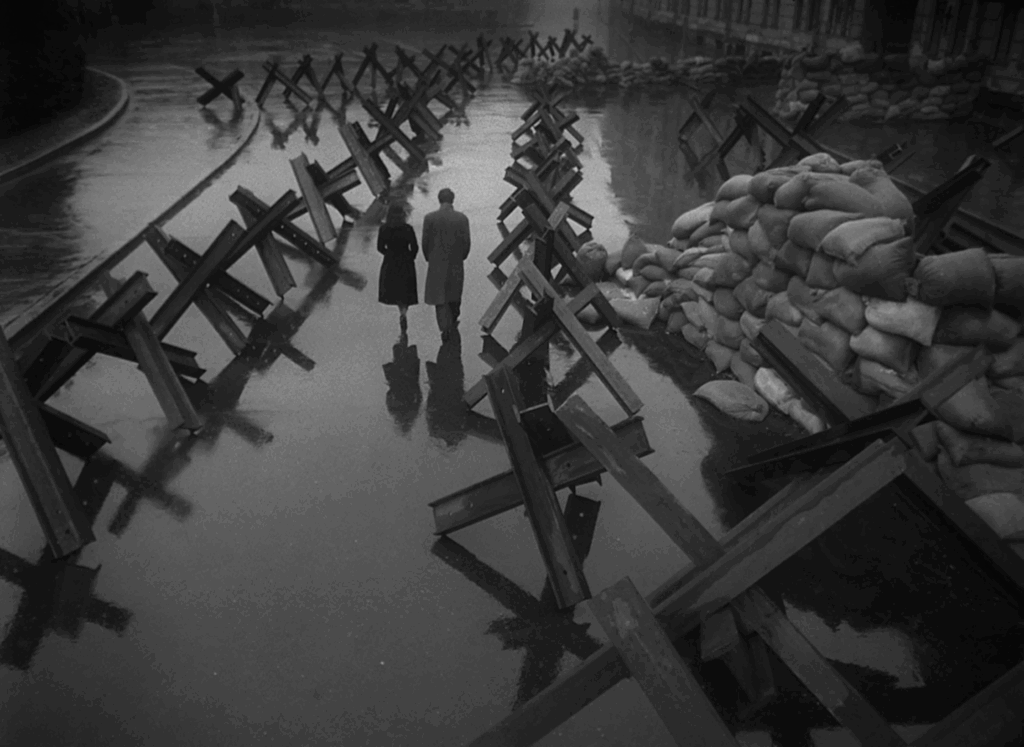
Fellini shoots on the barren outskirts of Rome, relegating Cabiria to a small hovel at the bottom of society.
The lavish mise-en-scène inside this extraordinary Italian villa is a welcome break from the rugged streets of Rome – and it is only fitting that it should be snatched away from Cabiria in such a cruel manner.

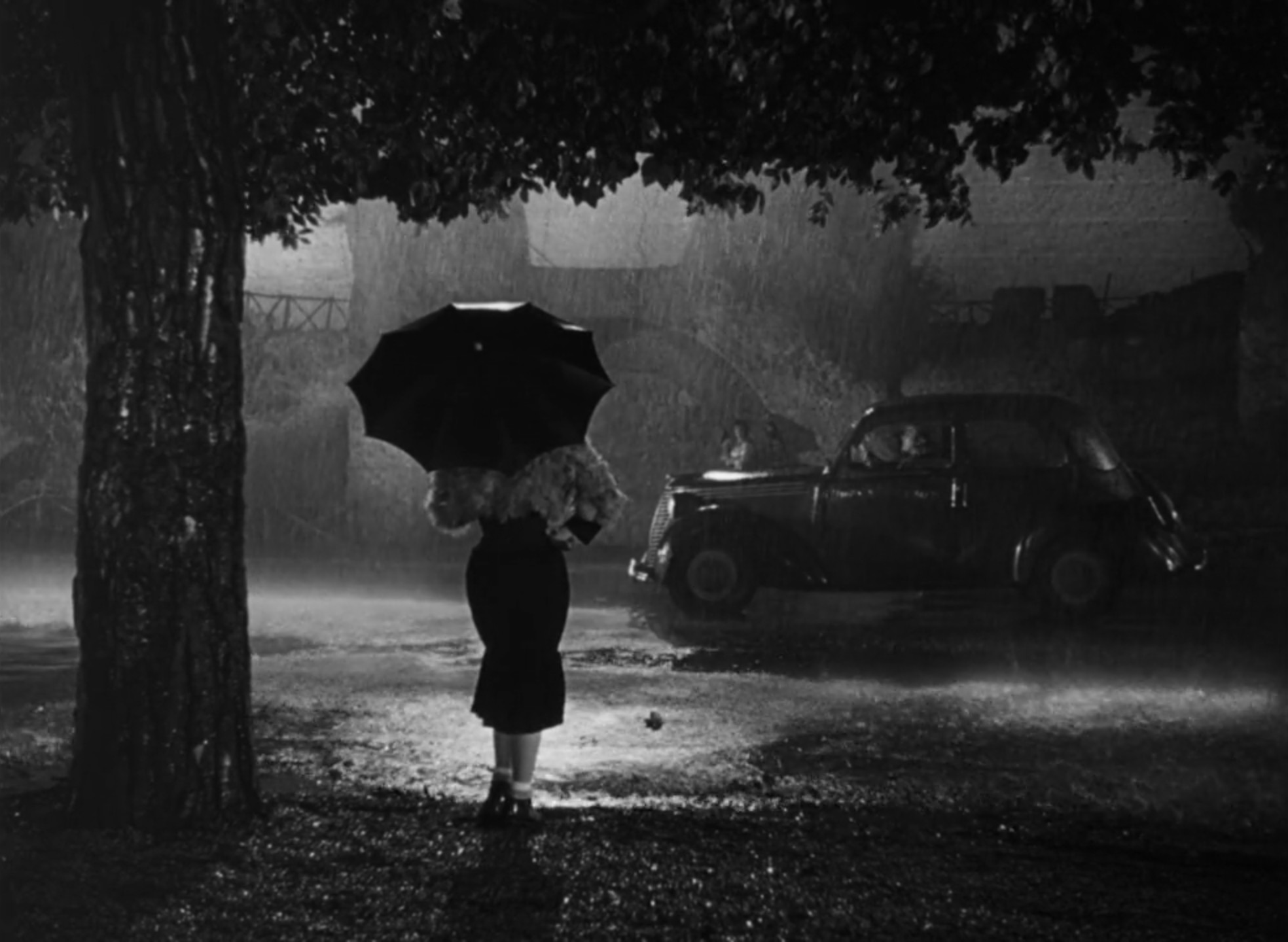
Besides this brief but extravagant detour, Fellini’s location shooting out on the streets of Rome firmly entrench Nights of Cabiria in the harsh realities of the working class and their tedious routines. His deep focus lenses allow for some magnificently staged compositions of prostitutes loitering around cars and curbs, while the occasional addition of black umbrellas to these shots underscores the cold, wet discomfort of their lifestyles.

Living in environments as inhospitable as these, it is no wonder Cabiria is so awed by acts of altruism, even being stirred to seek mercy at the aforementioned shrine of the Madonna after observing one mysterious stranger feeding the homeless just outside the city. Much like the men in her life though, religion simply turns out to be another disappointment, leaving her and all the other hapless worshippers she prays with in the same destitute position as before. Maybe she just didn’t ask properly, one priest unhelpfully suggests, but she believes the problem goes deeper than that – she is simply too small and insignificant to live in God’s grace.

Rome becomes its own coarse character in Fellini’s location shooting, towering in dilapidated buildings and sinking its citizens into shadows.
Waiting for customers out on the cold streets, Cabiria and her fellow prostitutes stand beneath umbrellas, shielding themselves from the rain.

On the other hand, there is not exactly any sanctuary to be found in Satan’s seductive allure either, taking the symbolic form of a magic show run by a devil-horned hypnotist. As she stands onstage under his spell, Fellini fades the background into darkness, leaving only her face illuminated by a single spotlight beckoning from the void. For the first time, her peaceful, dreamy expression is wiped completely of any doubt, being entirely absorbed in the perfect world the magician has built for her. To the amusement of the audience, she dances a waltz through a garden with an imaginary man called Oscar, and inadvertently reveals her most personal fantasies for the world to laugh at.

Satanic and divine imagery captured in a single scene, lulling Cabiria into a vulnerable state through devious illusions, and composing this image of eerie peace.

Cabiria’s humiliation at being turned into cheap entertainment might almost be the end of her were it not for the near-mystical manifestation of the man from her dream, astoundingly also called Oscar. Fellini has firmly established his narrative’s pattern of broken and mended hearts by this point, so we are aligned in Cabiria’s initial suspicion around this seemingly perfect man, but she can only keep her naïve idealism at bay for so long before falling in deep love all over again. It isn’t long before she is accepting a marriage proposal and selling her small house to move far away, partly realising how naïve she is being, and yet nevertheless committing enthusiastically to her dream of new beginnings.

Upon a clifftop, Cabiria and Oscar’s silhouetted figures look out at the sun setting over a peaceful lake, and a happy ending finally seems within reach – but Fellini is no writer of fairy tales. This magical backdrop is undeserving of the brutal narrative pay-off that taints its scenery, formally mirroring the film’s first scene as Cabiria once again faces the threat of being robbed and thrown into the water. The mercy that Oscar takes on her is not out of love, but rather sheer pity as she willingly hands over her purse and begs to be killed, her heart unable to sustain any more pain.

This gorgeous backdrop of the sun setting over a lake is undeserving of the brutal narrative pay-off that taints its scenery.

Still, even at Cabiria’s lowest and Fellini’s most cynical, the rekindling of hope need not be some naïve submission to the same cycle of suffering that has perpetuated throughout Nights of Cabiria. After several hours laying and sobbing on the cliff edge, the pieces of a broken woman pick themselves up again, and she dejectedly continues down a nearby road. Very gradually, the sound of Italian folk music fills the air, and she is surrounded by musicians rapturously playing and dancing alongside her. For once she is part of a crowd that is not only acknowledging her, but delighted to have her present. A single tear forms in the corner of her left eye, black with mascara, and as she looks directly at the camera in the final seconds, we find an unfamiliar self-acceptance in her tender smile. This is not the end of Cabiria’s tragedies, though for as long as she holds onto the hope that keeps her alive, neither will it be the end of her profound joy.

Fellini of course chooses to end his film with Masina’s eyes, breaking the fourth wall with a tender smile of self-acceptance and assurance.

Nights of Cabiria is currently streaming on Kanopy, and the Blu-ray is available to purchase on Amazon.

Throne of Blood (1957)

Akira Kurosawa | 1hr 50min

Akira Kurosawa’s cynical landscapes of ambition, fate, and consequences make for a perfect marriage with Shakespeare’s grand historical tragedies. “This is a wicked world. To save yourself you often first must kill,” decrees Lady Asaji to her husband General Washizu in Throne of Blood, respectively standing in for Lady and Lord Macbeth, and possessing the same cutthroat megalomania. Like their literary counterpoints, Washizu and Asaji’s futures are written out by the prophecies of mysterious, supernatural forces far beyond their comprehension, raising them to great heights before sending them plummeting back to Earth as mortals terrorised by their own guilty consciences. The formal groundwork is there for a narrative steeped in centuries-old storytelling traditions, and yet it is through Kurosawa’s adaptation of the Scottish tragedy that Throne of Blood takes on new dimensions within feudal Japanese history, warping the doomed General Washizu into a figurehead of samurai brutality.

Especially significant to this reinterpretation of Macbeth is its fresh setting during the Sengoku period – a time of civil wars through the 15th and 16th century which saw samurai clans fight for political control of Japan. The romanticised code of honour they are often nostalgically associated with bears no relevance here, and instead leaves a moral vacuum for treacherous social climbers looking to exploit weakened political structures.

Traditions and designs of feudal Japan are substantially present in Kurosawa’s Macbeth adaptation, using giant wooden fortresses and samurai armies for his vast scenic backdrops.

Kurosawa stages such power plays against bleak, greyscale landscapes of giant wooden fortresses and overgrown forests in Throne of Blood, spilling personal conflicts out into monumental battle scenes featuring hundreds of extras. Just because his visual stylisation doesn’t reach the level of Seven Samurai or Rashomon doesn’t mean his talent for deep focus blocking isn’t on lush display, but even more deserving of praise is his his aesthetic use of weather to confront his characters with the might of the natural world.

Thick fog constantly rolls across Kurosawa’s scenery, cloaking it in an air of supernatural mystery.

Most prominently, thick clouds of fog roll across his barren hills and valleys, obscuring horizons and disorientating Washizu as he makes his way home from war at the start of the film. It has an almost ethereal quality to it, seeming to emanate from that evil spirit which sits in a cage of bamboo and forecasts the samurai commander’s rise to power. Rather than taking the form of a witch, this soothsayer is far more ghostly in appearance, and later even wispily floats through a misty forest crowded with dense, black branches as it delivers the fateful second half of its prophecy.

The three witches are replaced with a prophetic evil spirit in Throne of Blood, and Kurosawa designs a haunting environment around him with the mist and crowded, black branches of the forest.

The other spectre who materialises in Throne of Blood belongs to Washizu’s friend, Miki, who he kills out of paranoid concern for his own security. The ghost’s supernatural arrival unfolds in one smooth dolly shot at a banquet, pushing forward past an empty seat towards Washizu’s anxious face, and then pulling back to reveal Miki’s spirit now occupying that space. Whether he is an apparition that has come to haunt his murderer or merely a psychological manifestation of guilt, his mysterious appearance heralds even severer weather, with rain whipping the castle in a violent gale and lightning flashing across the sky.

A fluid tracking shot forwards and back again to reveal Miki’s pale ghost, silently tormenting Washizu at the banquet and driving him mad with guilt.

Even Kurosawa’s direction of the final act’s foretold ‘moving forest’ arrives like a primal force of nature, emerging from the thick fog and advancing with the heavy wind towards Washizu’s fortress. It is a smart choice for Throne of Blood to omit the passage from Macbeth which plainly describes the enemy’s disguise, as Kurosawa instead hits us with the frightening sight of these trees coming to life at the exact moment that Washizu recognises his own impending mortality. His ego and power may be mighty, but even that cannot stand up against the power of the ancient, formidable powers of fate.

Kurosawa visualises the moving forest as a primal force of nature, ripped up from its roots and animated by the sheer power of prophetic destiny.

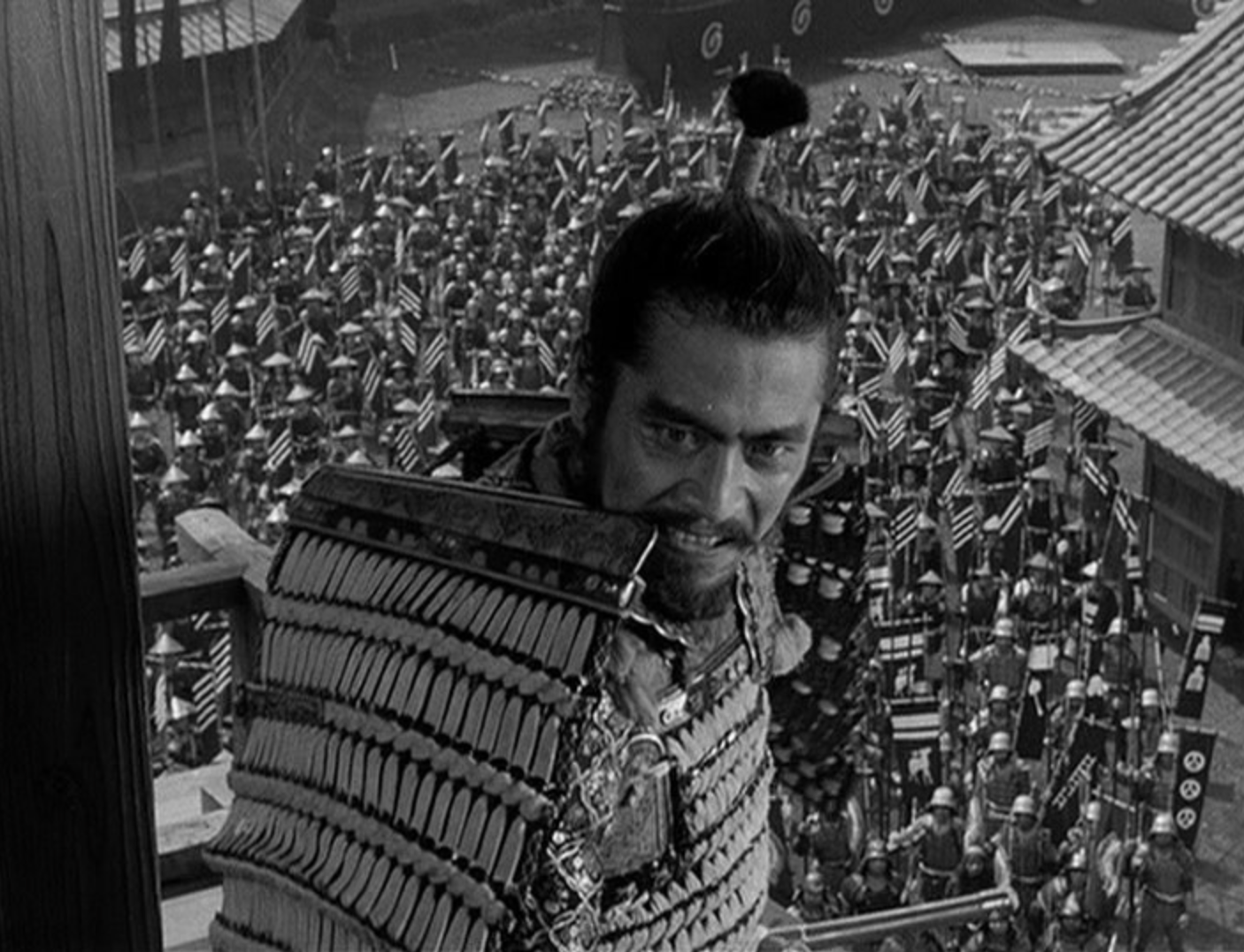
Motivated as much by fear as he is ambition and arrogance, the crazed Washizu does not waver, and neither does Toshiro Mifune in his single greatest moment as this Japanese incarnation of Macbeth. His fiery eyes light up the screen as a gleeful snarl stretches across his face, while behind him Kurosawa sets a majestic military backdrop of samurai raising flags and banners in crumbling fealty. This leads into another alteration of Shakespeare’s original text, and perhaps the most significant. With the prophecy that ‘no man of woman born can harm Macbeth’ absent, Washizu’s death is placed in the hands of his own disillusioned men, imbuing this legend with a revolutionary turmoil that grounds it even deeper in Japan’s politically unstable Sengoku period.

Throne of Blood’s single greatest composition with the backdrop of samurai behind Washizu – epic historical imagery.
Toshiro Mifune’s is incredibly animated as Washizu, lighting up the screen with his crazed eyes.

In extreme contrast to Mifune’s wide, crazed eyes, Isuzu Yamada displays Lady Asaji’s expressions like wooden masks, not unlike those worn by performers of Noh theatre. The guilt she exhibits is of an entirely different kind to Mifune’s fierce insecurity – rather than lashing out, she is found delusionally trying to clean her hands of blood that isn’t there, with her face contorted into the static image of a demonic hannya mask and her honed gestures mimicking those of Noh tradition.

In contrast to Mifune’s wildly expressive autocrat, Isuzu Yamada plays a much subtler and more cunning villain – very influenced by the masked performances of Noh theatre.

Kurosawa continues to weave these elements of Japanese theatre even deeper into its structure through his austere musical bookends, summarising Throne of Blood’s narrative into a couple of short, choral verses as fog continues to roll through the grey scenery.

“Look on the ruins,

Of the castle of delusion.

Haunted now only,

By the spirits of the dead.

Once a scene of carnage,

Borne of consuming desire,

Never changing,

Now and for eternity.”

Like the music of Noh theatre, these chants are limited in tonal and dynamic range, moving through repetitive patterns that restore a sense of order to Kurosawa’s world of subversive chaos. Tradition is the bedrock of these cultures, as ingrained in their social structures as it is in the laws of a calm yet overwhelming universe, and continuing to be carried out by forces of nature and destiny when humans fail to uphold its rigorous standards. Few films have truly captured the cinematic potential of Shakespeare onscreen in the art form’s history, and perhaps none with as much creative formal finesse as Kurosawa’s cynical exposure of the treacherous dishonour entrenched in samurai history.

Throne of Blood is currently streaming on The Criterion Channel.

Pyaasa (1957)

Guru Dutt | 2hr 33min

Often cited as the peak of Bollywood’s Golden Age, Pyaasa bursts with visual and musical splendour, adopting the passionate romanticism of the struggling Urdu poet at its centre. Vijay’s lyrical expressions range from melancholy laments over his nation’s social issues (“Where are those who are proud of India?”) to light-hearted jingles (“A single touch of this strong hand will dissipate all woes”), each imbued with the same sensitive eloquence which Guru Dutt carries in his performance and direction. On either side of him, two women vie for his love, though this is no simple repeat of Aar Paar from three years earlier. Pyaasa is far more sombre in tone, playing out the humanistic drama of Vijay’s personal tribulations, intimate desires, and efforts to have his work published. The wealthy Mr Ghosh could be the man to make those ambitions a reality, if only he wasn’t so jealous that Vijay was his wife’s first true love.

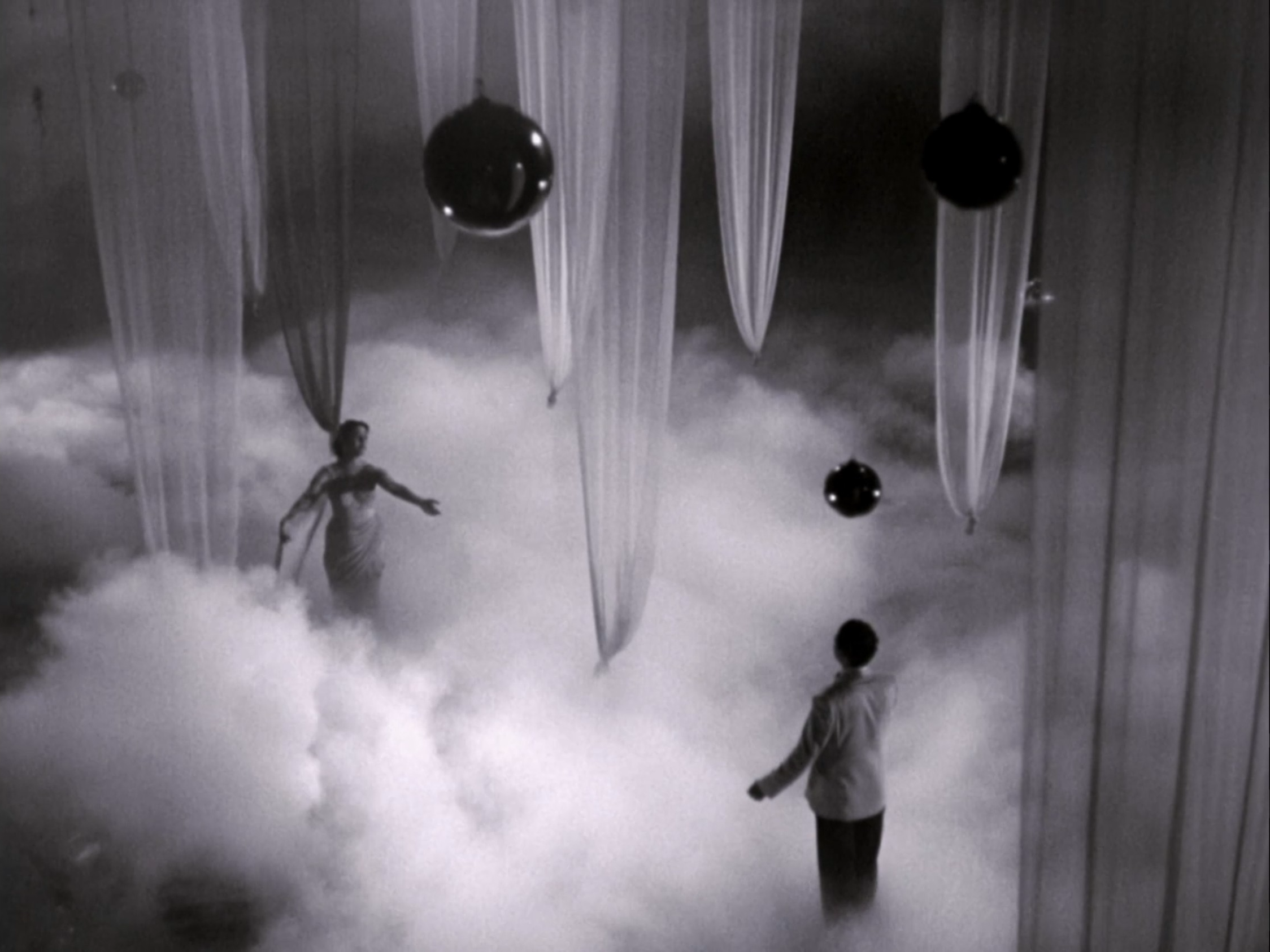
Clearly Vijay isn’t quite over his old flame either. Meena falls back into his life by chance as he mournfully sings of life’s sorrows up on a stage, before catching her face in the audience. Therein lies the romantic catalyst for what is Pyaasa’s defining cinematic moment – a surreal escape into the dreamscape of Vijay’s mind. A magnificent staircase winds its way up to a cloudy night sky, where Meena is gracefully silhouetted against a giant full moon. As she makes her way down among hanging baubles, Vijay walks through elaborate iron gates and across a mist-covered floor, where the two sing hypothetical questions of a revitalised love to acoustic guitar accompaniment in ‘Hum aapki aankhon mein’.

‘Hum aapki aankhon mein’ is the strongest Dutt has ever been in his impressive career, crafting an ethereal dreamscape of atmospheric lighting, giant sets, smoke machines, crane shots, and astonishing shot compositions.

Balloons and drapes billow in the light breeze around them, but most notably it is Dutt’s breathtaking camera movements through crane and dolly shots that lift the musical number into something truly transcendent. By the end of this song Meena has floated back up to the top of that stairway, just out of reach like some distant, celestial being, thereby set drastically apart from Vijay’s other love interest.

Billowing curtains, falling balloons, hanging baubles, ornate lanterns – this musical number is designed to look as if Vijay and Meena are dancing atop clouds in their own personal heaven.

Along a parallel narrative thread, we find local prostitute Gulabo, coming into the writer’s life one lonely night after his brothers have pawned off his manuscripts as wastepaper. While mourning his lost lyrics on a park bench though, he hears them being sung to him as a sly temptation. Entranced just as much by his desire to reclaim his papers as his romantic curiosity, he follows the seductress back to her home, while Dutt’s camera elegantly glides with them through magnificent colonnades and shifty alleyways. Though she spurns him after realising he is penniless, the discovery that he penned those words sees her undergo a change of heart. From here, Vijay’s relationship with Gulabo is defined by mutual compassion and gentle longing. As a sex worker, she has suffered a great deal of abuse at the hands of men, and so their romantic connection becomes a haven of sincere empathy.

Tracking shots through colonnades when Vijay first meets Gulabo and follows her home. Dutt’s moving camera is crucial to the artistic success of Pyaasa.

Dutt may have leant on his visual obstructions more heavily in previous films, but they very much play a key part in this romance too, frequently obscuring Vijay and Gulabo behind the stair bannisters of her apartment building. His oppressive use of set décor is also drawn throughout the rest of the film, imposing Calcutta’s urban infrastructure on crowded sets that emphasise the distance between lovers, such as the exquisitely poignant rooftop scene during the number ‘Aaj Sajan Mohe Aang Laga Lo’. On the occasion that Dutt does choose to shoot on location, this depth of field brings a raw grit to the drama, landing us on the riverbank of the Ganges when Vijay learns from his brothers of his mother’s passing and turning its industrial architecture into harsh backdrops.

Dutt returns to these shot obstructions multiple times on the stairway up to Gulabo’s apartment – a visual device that he would emphasise more heavily in Aar Paar, but which is still potent here.
Some of the film’s best scenes are shot on location. Certainly this is inspired by the Italian neorealists, but Dutt continues it here in India by the Ganges.

With poverty, sex work, corruption, and death underlying this narrative, Pyaasa proves to be a particularly morose, and at times even slightly neorealist film for Dutt. That his sullen brooding and understated reactions are so distinct from his comic performance in Aar Paar is a testament to his versatility as an actor too, though he and his fellow cast members are also lent immense gravity here with the camera so frequently dollying in on their faces illuminated by moody, low-key lighting setups.

Always the dolly shots in on actors’ faces, drawing us in and out of their aura.

Commanding a sombre tone with such grace is no easy feat, but Dutt pushes it even further in building his narrative to a Sullivan’s Travels-style third-act twist, seeing Vijay presumed dead in a train accident and temporarily rendered an amnesiac in a mental hospital. Even when his memories return, he is met with disbelief, all the while his poems he had been trying to get published have taken off thanks to Gulabo’s efforts of persuasion. Of course, to Mr Ghosh it is all just an opportunity to capitalise on recent tragedy, and even Vijay’s own brothers conspire with him to receive a cut of the profits by misidentifying the body of a homeless man.

Dutt’s sets may be simple, but there is always so much detail in the way he frames them, here using the balcony like the famous Romeo and Juliet scene.
Detail and blocking even in throwaway shots, always framing Vijay against his surroundings and other characters.

How quickly loyalties change though when he finally does manage to escape from the hospital on the anniversary of his ‘death’ and make a grand public appearance at his memorial service. Inside this magnificent hall, the scale of Dutt’s photography is colossal, symmetrically framing Vijay in the doorway between masses of grieving fans. Crane shots sweep over the crowd as they stand in unison, gazing in disbelief at this resurrected Christ figure who has returned to set things right. The editing too is especially involved in this sequence, subtly matching the rhythms of Vijay’s lyrical chastisement of Mr Ghosh’s greed in ‘Ye Duniya Agar Mil Bhi Jaye’.

“This world of palaces, of thrones, of crowns,

This world full of enemies of humanity,

This world which is only hungry for money,

Even if one could have this world, so what?”

Another massive visual and musical highlight, as Vijay makes his Christ-like return to the world in a hall of adoring fans, and Dutt sweeps his camera in crane shots above them all.

And of course, much like Christ himself, Vijay rejects the fame, riches, and power offered to him, right at the moment when he could have seized it all. The frustration that has accumulated towards society’s hypocrisy and materialism all through Pyaasa finally explodes with disenchanted anger, seeing him deny his own name and eventually retreat into obscurity with one last monologue.

“I complain against a society that tears away a man’s compassion. That makes a brother, a stranger, a friend an enemy for self-interest. I complain against a culture, a world which worships the dead, and tramples the living underfoot. Where it is considered cowardice to cry for the suffering of others, where it is considered a weakness to respect others. In such an atmosphere, I shall never find peace.”

How fitting it is that he turns to prose in this moment, exiting the room with Gulabo just as a gust of wind picks up his poetry and scatters it in a dramatic flurry of papers. Dutt is a master of kinetic imagery, punctuating this decisive character turn with an equally powerful composition, and effectively wiping Vijay’s slate clean for a more hopeful future. The idealist we met at the start of the film is not the man we see here, now resolving to give up on a ruined world and leave with his cherished love before society gets a chance to corrupt that too. Though Pyaasa flows with both incredible joy and profound cynicism, Dutt’s lyrical camerawork continues to guide us through broad sweeps of emotion with stylish bravado, bleeding a uniquely Indian sentiment that marks it as his crowning achievement.

A perfectly cynical yet sweet ending, seeing Vijay turn away his chance at fame having grown jaded with its corruption, accepting a much simpler life with Gulabo. His manuscripts blow across the room in a beautiful flurry, carelessly throwing his years of work to the wind.

Pyaasa is currently streaming on Amazon Prime Video.

Wild Strawberries (1957)

Ingmar Bergman | 1hr 31min

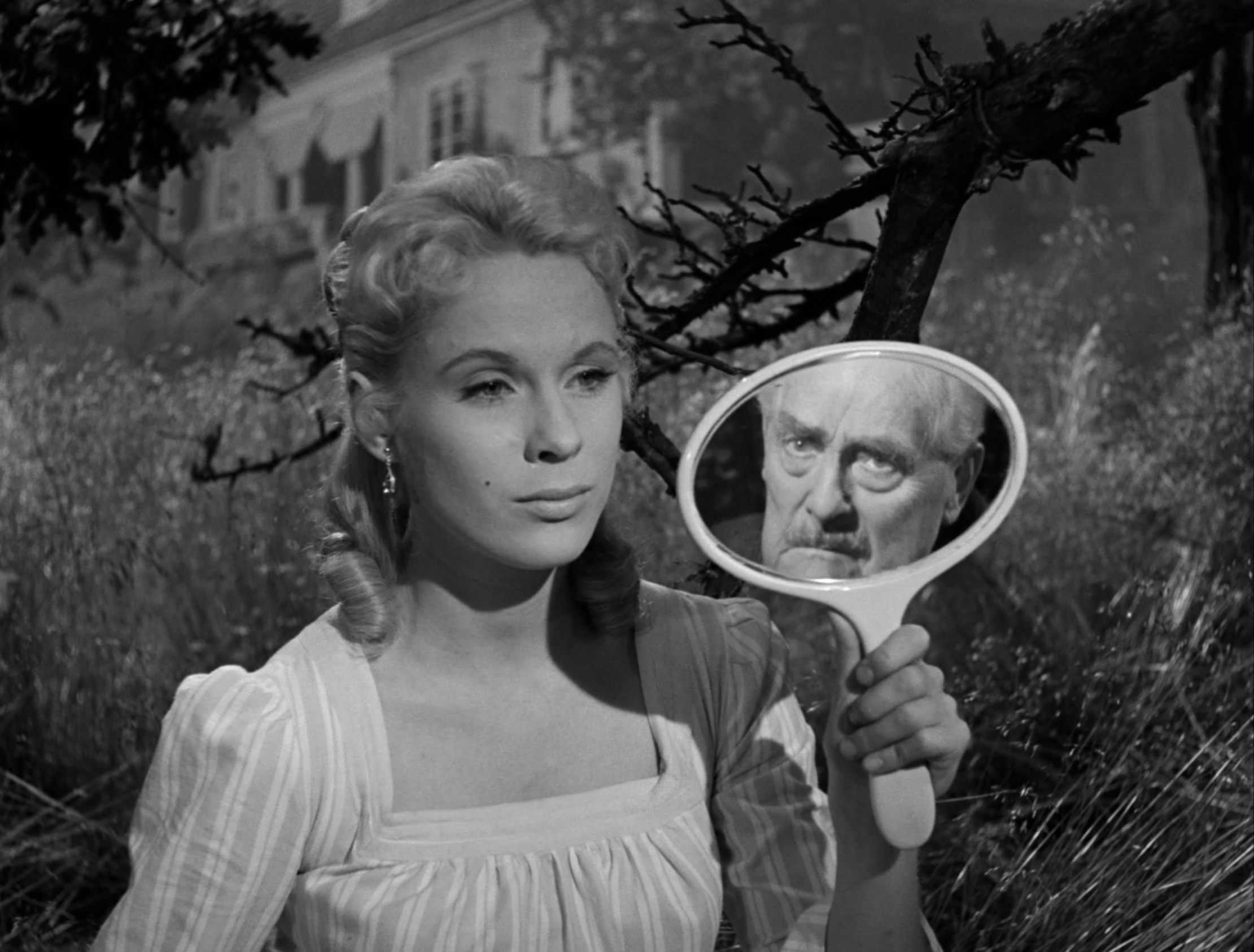
Within the first ten minutes of Wild Strawberries, a surreal nightmare unfolds in the mind of Professor Isak Borg, prompting a sudden shift in his travel plans. The empty city streets he anxiously wanders are blown out in high-contrast monochrome, blinding us with the glare of white pavement and dissolving shadows into inky voids. A clock without hands marks the timelessness of this dream space, but also warns of Isak’s own impending death. Time is running out. A man with a seemingly painted-on, scrunched-up face melts into a dark liquid, and a driverless carriage led by charcoal-coloured horses topples over, tossing a coffin out onto the road. Inside, Isak finds himself. He wakes with terror, and a mysterious new resolution – he will not take a plane to the ceremony where he will be receiving the honorary degree of Doctor Jubilaris that evening. Instead he will drive, and with his daughter-in-law Marianne in tow, he sets out on a physical and spiritual journey of self-reckoning.

Bergman delves into surrealism in Wild Strawberries in a way he had never done before. The over-exposed photography of the professor’s unsettling dream sequence is a brilliant wordless sequence, sinking him into an existential terror of his own mortality.

This existential search for life’s answers makes for a fascinating companion piece to the other Ingmar Bergman film that came out in 1957, The Seventh Seal, with both marking a new trajectory in his career towards more philosophically minded films. Their combined success also venerated him internationally as a filmmaker not to be underestimated, and there may even be a passing of the torch here from one acclaimed Swedish director to another in his casting of Victor Sjöström. Though Bergman had previously used him in To Joy as a supporting character, he is front and centre here as the elderly physician facing up to his troubled past and unsettling future, reflecting on them with sorrowful dissatisfaction. Despite his professional achievements, Isak is a man who has steadily distanced himself from those he once held dearest, and over the course of this road trip each arrive back into his life in the most unexpected ways.

This predominantly takes place through the bleeding together of dreams, memories, and symbols, drifting by on the powerful current of Bergman’s poetic screenplay. “The day’s clear reality dissolved into the even clearer images of memory that appeared before my eyes with the strength of a true stream of events,” Isak eloquently contemplates, as Bergman quite literally dissolves the barriers between his material and psychological worlds via his graceful scene transitions. When the professor rests against the car window and considers “something overpowering in these dreams that bored relentlessly into my mind,” his voiceover is visualised with a slow fade into the past, sending a murder of crows flying across his sleeping head.

One of the film’s finest compositions arrives in this long dissolve, send a flock of crows flying across Isak’s head as we slip into his dreams.

It is especially his visit to the summer house he visited throughout the first twenty years of his life that opens the floodgates of nostalgia, playing out his romance with the beautiful Sara who would eventually marry his brother, Sigfrid. While everyone else around Isak in these flashbacks is young, Sjöström continues to play Isak as his older self, fully inhabiting his own memories. As his white-clad peers gather and pray around a table in preparation for dinner, Bergman’s camera tracks forward into the room through a dark doorframe, and Sjöström lingers shamefully on the shadowy edges in his black attire, clearly set apart from these days of romantic idealism. In the present, Isak can’t help but draw comparisons between his old sweetheart and a hitchhiker similarly named Sara – and apparently neither can we, given that both iterations are flanked by rivalling suitors and played by frequent Bergman collaborator Bibi Andersson.

A doorway opening from darkness into the light, visually drawing a threshold between Isak’s present self and his past.
Bibi Andersson plays two roles in Wild Strawberries, both called Sara and both mirrors of each other. It isn’t just an impressive performance from her – it is a great piece of formal characterisation from Bergman too.

She isn’t the only modern surrogate calling back to Isak’s past either. When he picks up Sten and Berit, a married couple with a broken-down car, their mutual resentment reminds him of his own relationship with his late wife. It is a miracle that Bergman’s early scenes of Isak and Marianne alone in the front seat are so visually engaging with their piercing deep focus, but it is when he fills the car to the brim that the genius of his blocking is truly revealed, forming layered representations of Isak’s past and present. Right in the back we find Sara and her two men, calling back to his adolescence. In the middle seats, Sten and Berit’s bickering continues to fill him with raw regret over his marriage, and leaves everyone else to sit in awkward silence. And there in the front driver’s seat right by his side is Marianne, his sole connection to his estranged son, Evald.

Bergman’s blocking and marvellous depth of field serves more than just his stark aesthetic. There is so much information conveyed a single shot here, representing different layers of Isak’s memories across each row of car seats.

Gunnar Björnstrand makes minimal appearances in this role, but there are definitive resemblances between his and Sjöström’s performances, both being cynical, irritable men who care little for their wives. Clearly the sins of the father have been passed onto the son and perhaps even amplified, as Evald is quick to cut down Marianne’s desire to bear children. “Yours is a hellish desire to live and to create life,” he heartlessly proclaims in her flashback, sitting in the exact same car seat that Isak is in now. “I was an unwanted child in a hellish marriage.” To look back at this family history from the other direction, it is clear that Isak may have inherited the same prickly attitude from his own parents too – specifically his mother, who Marianne describes as “cold as ice, more forbidding than death.” During his short visit to her along the road trip, she hands him the gold watch that his father used to own, which in a disturbing turn of events is revealed to not have any hands much like those of his dream.

We cut between the present and the past in this car, and just in his staging Bergman draws comparisons between Isak and his estranged son.

Bergman had certainly dabbled in magical realism before, but surrealism as concentrated as this is new for him in 1957, penetrating the depths of his protagonist’s mind in such ways that can only be felt via absurd, impressionistic imagery. In a law court preside over by the quarrelling husband Sten, Isak is forced to read nonsense on a blackboard that he is informed translates to “A doctor’s first duty is to ask for forgiveness.” He stands charged of being incompetent, as well as many minor offences including “callousness, selfishness, ruthlessness,” each brought against him by his wife who is deceased in the reality, yet lives on in his mind. A rippling reflection in a dark pond bridges one dream world to the next, where he finds a memory of his wife carrying out an affair in the forest, and contemplating his impassive reaction back home when she eventually tells him of her infidelity. Soon, she and her consort disappear without a trace, and Sten becomes a dark reflection of Isak’s subconscious, considering the doctor’s meticulous method of emotional detachment.

“Gone. All are gone. Removed by an operation, Professor. A surgical masterpiece. No pain. Nothing that bleeds or trembles. How silent it is. A perfect achievement in its way, Professor.”

Perhaps he would have found more satisfaction in the university’s ostentatious ceremony the previous day, but now as he accepts his certificate and listens to speeches, there is a strange emptiness to the routine proceedings. Is this the legacy he has made for himself?

We can always expect an array of marvellous compositions in Bergman’s dream sequences, catching the light of reflections in a rippling pond and often obstructing the camera.

With his manifestations of old memories in his current reality though also comes second chances for all those still alive. “I can’t live without her,” Evald confesses to his father, resolutely deciding to stay by Marianne’s side through the birth of their child. Through his newfound appreciation of his daughter-in-law, he also uncovers the dormant love for his own wife that he never showed during her life. Such are the power of dreams in Wild Strawberries, mulling through decades of nostalgic and shameful memories to reveal greater truths about oneself. By turning Isak’s car into the vessel through which he navigates such fantasies too, Bergman grounds them all in a robust visual metaphor. As the elderly professor now drifts off to sleep though, his face is not tormented by dark musings, but lightened by a gentle peace. “If I have been worried or sad during the day, it often calms me to recall childhood memories,” his mind echoes, before finally slipping away into worlds untouched by bitterness and regret.

A final escape into Isak’s dreams, though this time there is much greater peace in his resignation.

Wild Strawberries is currently streaming on The Criterion Channel, and is available to rent or buy on iTunes.

The Seventh Seal (1957)

Ingmar Bergman | 1hr 36min

Across the withering forests, squalid villages, and draughty castles of 14th century Sweden, there is resounding silence. It echoes through Ingmar Bergman’s sparse minimalism, emerging not from the peasants who dance and sing as distraction from their grim circumstances, nor from the religious zealots who preach portentous warnings of Judgment Day. It doesn’t even come from Death himself, who stalks the land and takes lives without discrimination. This silence belongs to an absent God, whose apparent withdrawal from His own creation brings omens of an unavoidable reckoning. Drawn from the Book of Revelations, the verse which opens this meditation on faith sets the scene for Bergman’s theological questions, leading us towards the end times with a pained longing for answers.

“And when the Lamb broke the seventh seal, there was silence in heaven about the space of half an hour… And the seven angels which had the seven trumpets prepared themselves to sound.”

From this biblical quote also comes the title Bergman gives his film, The Seventh Seal, marking its events as the final catalyst for the Apocalypse. Seemingly every character from the cynics to the Christians acknowledges the dismal shift in the air too, as they spread rumours of supernatural occurrences and fearfully evade the Black Death.

Death, pestilence, madness, and torture infest the land in The Seventh Seal, and Bergman’s austere photography reflects that in its impeccable staging.

It isn’t hard to see why The Seventh Seal held immense cultural significance at the time of its release, speaking to audiences of 1957 who anticipated a nuclear winter during the early years of the Cold War. From a spiritual perspective though, it connects even more distinctly to Bergman’s own repressed upbringing as the son of a strict Lutheran minister. This did not inspire a rebellious attitude in him, but rather an instinct for curiosity, prompting him to search for traces of God in a world simultaneously obsessed with and disconnected from His holy virtues.

It makes sense then that Bergman gives his own philosophical quandaries in The Seventh Seal to disenchanted knight Antonius Block, played by Max von Sydow with intelligence, sorrow, and a desperate glimmer of hope. Having returned from the Crusades, Block is no stranger to serving the Catholic Church, and yet he has not found the spiritual fulfilment that was promised. “My life has been a futile pursuit, a wandering, a great deal of talk without meaning,”he laments, “But I will use my reprieve for one meaningful deed.” And yet where can one find such a purpose, if not from God?

Max von Sydow is served well by an all-time great script, but it takes a talented actor with a firm handle on such profound material to do it justice.

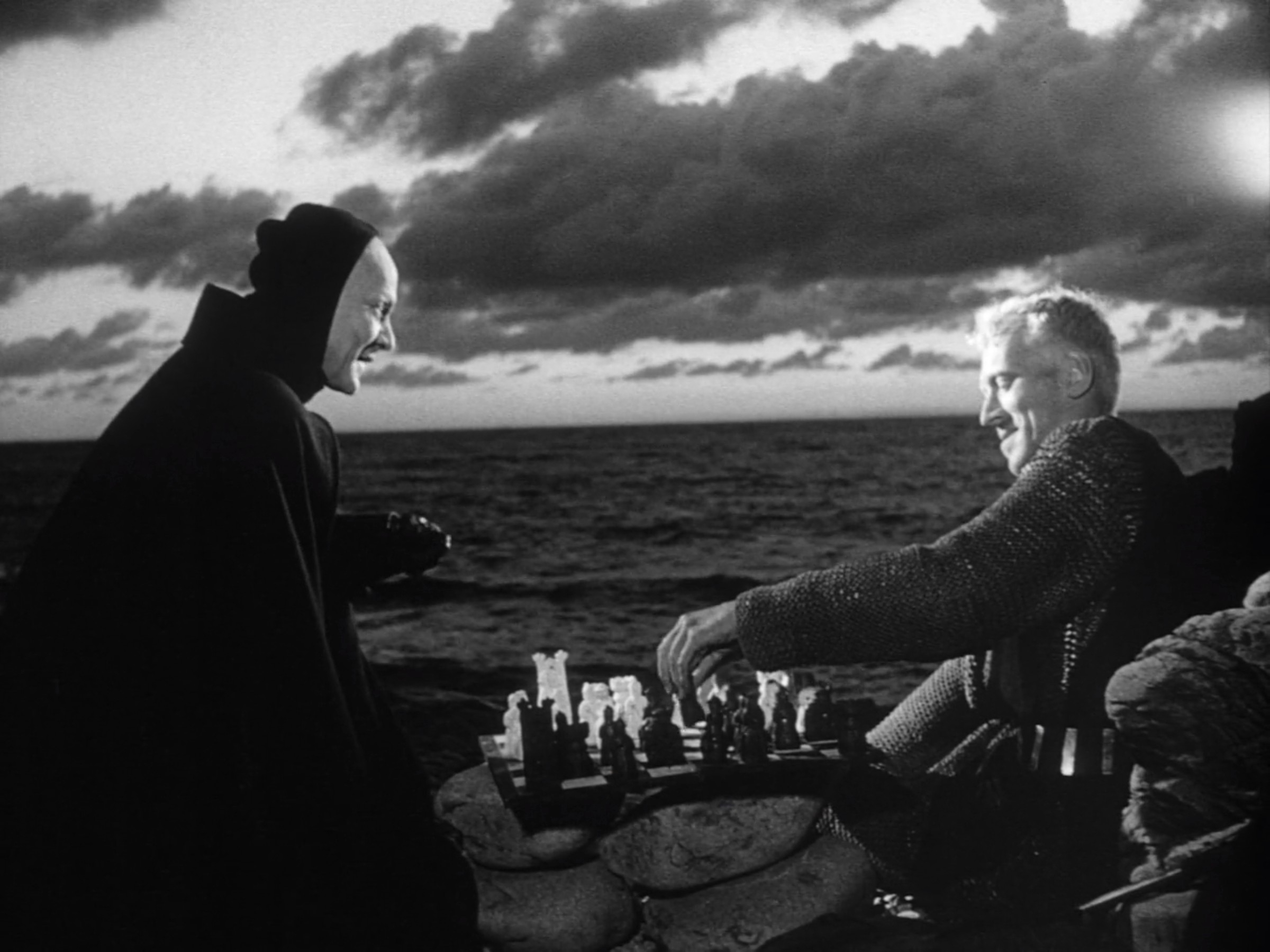
This paradox underlies Block’s journey in The Seventh Seal, driving him to seek wisdom from a mad woman who claims to have consorted with the Devil, as well as a priest who, as he eventually discovers, is in fact Death in disguise. When the knight first meets this mysterious, pale-faced entity on a rocky shoreline, he is told his time is up, and yet he is not ready. “My flesh is afraid, but I am not,” he confesses, before challenging Death to a game of chess – the stakes being his own life. Bergman pensively returns to this rich allegorical conceit throughout the film, with Death outsmarting Block at virtually every turn, and as such a timer is effectively placed on the knight’s uncertain quest to find meaning before his adversary checkmates him.

The first actors who should be praised for their work in The Seventh Seal are Max von Sydow, Gunnar Björnstand, and Bibi Andersson – but Bengt Ekerot’s literal embodiment of Death has become an icon in pop culture for good reason.
The chess game that unfolds between Antonius Block and Death is a symbol of fate and futility, and Bergman uses it as a superb frame here for the knight’s travelling companions in the background.

Bergman’s indelible iconography is woven all through The Seventh Seal, and yet it is this infamous image of von Sydow challenging Death which effectively escaped its niche corner of world cinema and spread into mainstream culture at large. Though Bergman clearly identifies with the doubtful knight, perhaps he also sees a bit of himself in the church painter, who the cynical squire Jons finds illustrating a large fresco depicting the Dance of Death. “I’m only painting things as they are. Everyone else can do as he likes,” he explains, handing the power of interpretation over to viewers of his work.

Theological questions are on Bergman’s mind, taking visual form in this exquisite composition that von Sydow walks into early on.

For as long as the artwork remains in Bergman’s hands though, he is a perfectionistic craftsman, painstakingly shaping his blocking and lighting into expressions of profound wonder, and instilling his austere imagery with a razor-sharp depth of field. In close-ups and mid-shots, he studies the expansive emotional range that crosses his ensemble’s faces as they confront their impending deaths with terror, confusion, anger, and awe. In wides as well though, he imposes a stark, greyscale beauty on his medieval scenery, confining these characters to barren lands upon which nothing fruitful can grow.

Blocking faces is right in Bergman’s wheelhouse, and The Seventh Seal bears some of his strongest compositions in this aspect, turning them at angles, staggering them through his depth of field, and obstructing them with his mise-en-scène.

Everywhere that Block goes with his steadily growing band of companions, a disconcerting rot eats away at the minds and bodies of the common people. In one scene that has taken root in pop culture (most prevalently through Monty Python and the Holy Grail) a comical performance by jesters is interrupted by a procession of God-fearing flagellants and monks, carrying a giant cross through the village streets and whipping themselves as self-punishment. Bergman keeps his camera close to the ground as they trample over us, chanting their mournful ‘Dies Irae’ motif which continues to weave into the score like a harbinger of doom.

One of the great scenes of the film, which would later be parodied by Monty Python. We sit at a low angle as a procession of monks, preachers, and flagellants interrupt a comical performance, dampening spirits with a deathly gloom.

At this moment, an astonishingly composed cutaway to the expressions of Block, Jons, and a mute girl they have picked up reveals their utter disdain, staggering their faces into the background. Bergman then follows up this shot with his camera tracking along a line of villagers, one by one kneeling to the ground in fearful reverence. The sermonising preacher who takes the stage effectively shifts attention away from the troupe of performers entirely, though in case we are driven to sympathise with any of them, Bergman also draws our attention to the affair their leader Skat is conducting with the wife of the town blacksmith. Through local cheaters, thieves, and self-righteous evangelists, moral debasement runs deep in this setting, and The Seventh Seal never fails to match such austerity with an equally severe visual style.

During the procession of monks, Bergman lands one powerful image after another, cutting between the sceptics and the believers.

Each time we return to scenes with naïve actor Jof and his family though, small sparks of levity quietly emerge in this story. His glimpse of a woman walking with her child may be brushed off as a hallucination, but he is convinced that they represent the Mother Mary and an infant Jesus. His other visions aren’t so easily dismissed, and even appear prophetic in nature – after all, he seems to be the only one outside of Block who can see Death playing their fatal game of chess. Our wandering knight’s brief picnic with Jof’s family on a hillside is the first moment of serenity that he finds in his journey, and as they share in wild strawberries to the peaceful sound of a lyre, Block starts to uncover the meaning of life he has pursued for so long.

The meaning of life begins to dawn on our troubled knight, as he joins these representatives of Mary, Joseph, and Christ for a picnic on a hillside.

And therein lies one of Bergman’s most significant symbols of The Seventh Seal, turning Jof, Mia, and their baby into surrogates of Joseph, Mary, and Jesus. Humanity’s salvation does not lie in dour warnings of doom, self-indulgence, or existential searches for purpose, as Block discovers, but in the birth and nourishment of new life. As for the one meaningful deed he wishes to accomplish, it presents itself as a selfless sacrifice during his last few rounds of chess. A clumsy toppling of the board may seem to his opponent a desperate way to try and escape his fate, and yet it is the first time Death has truly been outwitted. Not even he can comprehend total self-sacrifice as a strategic move, as he is distracted by Block’s deliberate blunder long enough for Jof and his family flee unnoticed.

“When we meet again, you and your companions’ time will be up,” Death informs his prey before departing, and indeed as Block finally returns home to his castle with his fellow travellers, a quiet recognition that they will not see the stormy night through settles over them. Recalling the peaceful meal he shared with Jof and his family, Block and his fellowship partake in a last supper together, while his wife reads out from the same chapter of Revelations which opened the film. Death enters the room silently but powerfully, his presence only revealed to us by the slow turning of faces towards a point just behind the camera, each one precisely arranged across the frame in expressions of disbelief. Only Block refuses Death eye contact, instead choosing to look up to the heavens and pray in the background. The window of light that Bergman frames right behind his head is the perfect finishing touch to this immaculate composition.

Bergman separates von Sydow from the rest of the ensemble in this shot, relegating him to the background and pouring in light above his head. He is the only one here not looking straight at Death, who stands just behind the camera.

Is it a flash of transcendent wonder which grants the mute girl Christ’s words as he hung on the cross, “It is finished,” or is her proclamation the result of some divine miracle, ending God’s crushing silence? There is beauty in this ambiguity, and all throughout his film Bergman deliberately balances such interpretations on a knife’s edge, denying us the comfort of conventional explanations. The Seventh Seal is a film of thought-provoking symbolism, but there should be no understating its achievement of screenwriting either, effectively reframing the classical hero’s journey within an expedition of biblical and philosophical significance. Its poetic dialogue too effortlessly flows from one existential contemplation to the next, delivering the sort of lines one might find quoted by theologians and sceptics alike. Especially as the surviving Jof spies their tiny silhouettes performing the Dance of Death atop a hill, he describes their movements with lyrical eloquence, allegorically detailing the transition from one life to the next.

“The strict master Death bids them dance. He wants them to hold hands and to tread the dance in a long line. At the head goes the strict master with the scythe and hourglass. But the Fool brings up the rear with his lute. They move away from the dawn in a solemn dance away towards the dark lands, while the rain cleanses their cheeks of the salt from their bitter tears.”

Perhaps those more religiously minded characters might view the parting clouds and fresh sunlight as a sign of Christ’s second coming. Bergman would never be so obvious though. The Seventh Seal stands among history’s greatest pieces of theological cinema, not for the moral lessons it imparts, but the questions it provokes, cutting to the core of our existential search for something larger than ourselves. Maybe there is also salvation in the opposite though – an acceptance of the “unknowing,” allowing one to graciously hand themselves over to the great equaliser of Death. Bergman remains torn between faith and doubt right to the end of his grand medieval fable, though only a director with as keen an eye for spiritual iconography as him could build both ideals to such a tender, hopeful resolution, recognising their essential place in humanity’s ever-expanding self-awareness.

The Dance of Death is an icon that stretches back to the Late Middle Ages, and Bergman wisely chooses to end his film on its image.

The Seventh Seal is currently streaming on The Criterion Channel and Kanopy, and is available to rent or buy on iTunes.

Forty Guns (1957)

Samuel Fuller | 1hr 20min

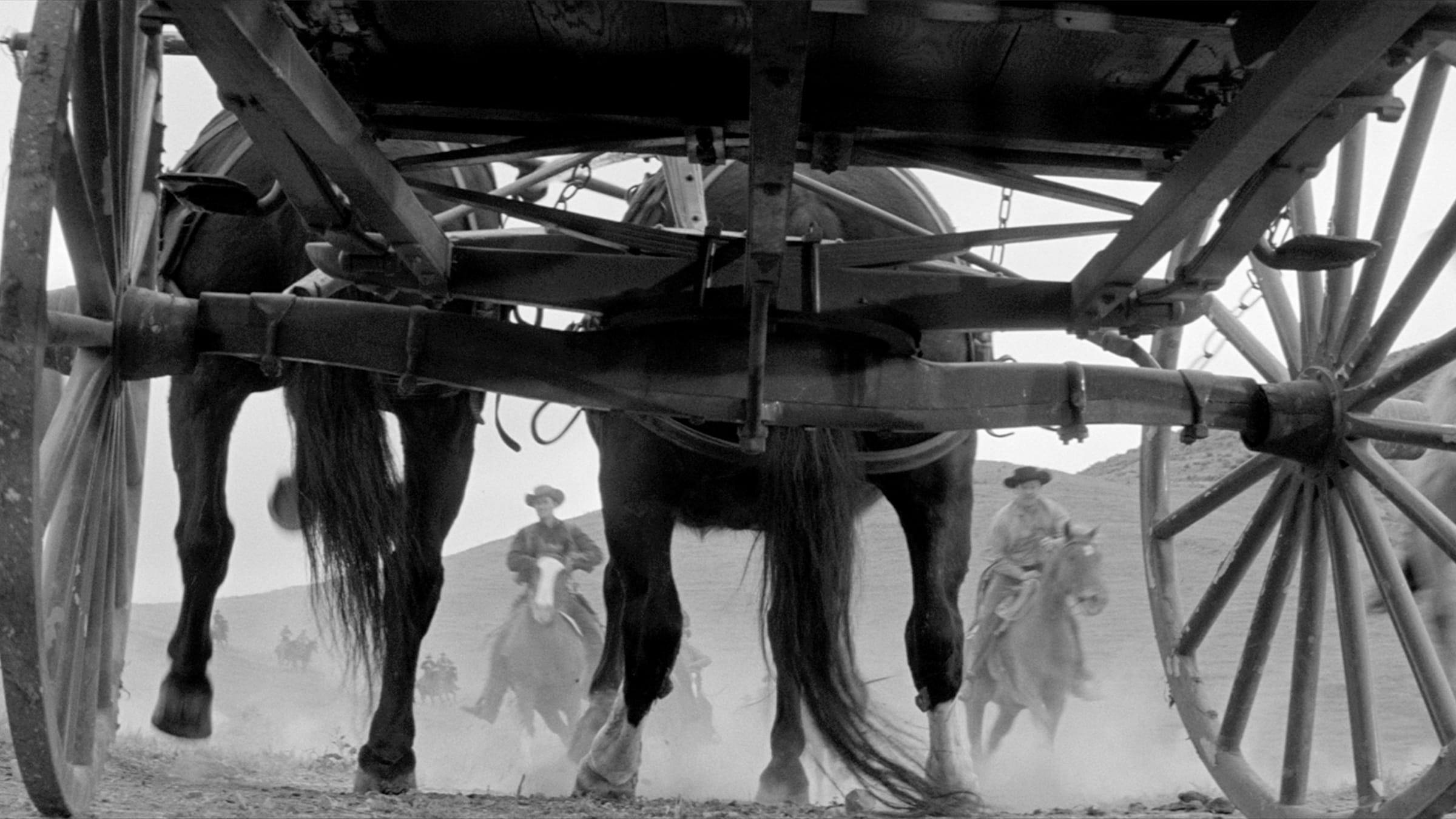
In this classical Western tale of law enforcers, landowners, and mercenaries, somehow Samuel Fuller always finds the most inventive angle to frame their vicious clashes. When reformed gunslinger Griff approaches the town of Tombstone in the opening scene and is rushed by a herd of cowboys, the camera peers out from under his wagon and horses’ legs, dangerously at risk of being trampled. After he arrives and is confronted by local troublemaker Brockie, we cut into an extreme close-up of his eyes while he confidently strides down the street, several years before Sergio Leone would use the exact same technique. When two of Brockie’s friends seek revenge, Fuller’s low angle reveals the hidden shotgun emerging from the window right above Griff, heightening the dramatic irony of his own obliviousness. Forty Guns draws significantly from the mythology surrounding lawman Wyatt Earp and his time spent restoring order to the real Tombstone, and yet in Fuller’s skilled hands, it becomes a refreshingly imaginative, female-centric fable.

An extremely low angle revealing the suspense and dramatic irony of the scene – a rifle emerging from a window above an oblivious Griff on the street below.
Fuller shoots and edits this showdown like a Sergio Leone film. When his camera isn’t right in Griff’s eyes with extreme close-ups, there is constant attention paid to the blocking and background. Especially in the second shot of the three above, there is such a clear sense of geography and tension conveyed through his intelligent staging.

She’s no public official, but Jessica Drummond wilfully rules this town with her forty hired gunmen by her side, while turning a blind eye to their own misdeeds. Next to Barry Sullivan’s passable lead performance, Barbara Stanwyck easily commands the screen in this role, adding the Western genre to her repertoire of melodramas, noirs, and screwball comedies that she had already proven her hand at. Whether she is aiming to inspire laughter or fear though, there is often a hardy resilience to her characterisations, and it only matures here in her middle age. When an arrest warrant arrives at her headquarters, Fuller follows its movement through the hands of twenty men lining a table, and at its head Stanwyck sits as a calm, authoritative figure, letting the sheer quantity of men beneath her speak for itself.

A letter is passed through the hands of twenty men lining one side of this extra long table, leading to Barbara Stanwyck at the end – the most powerful of them all.

The cool fluidity of Fuller’s camera movement is weaved all through Forty Guns in some remarkable tracking shots, the longest of which set a record at Fox Studios with its four-minute take descending the side of a building and traversing the entire length of the town. In a more delicate scene after Griff saves Jessica from being swept away by a tornado, the two rivals find an unlikely romance burgeoning between them, and as they lie on the floor of a barn, the camera gradually floats down from its rafters towards them. Bit by bit, Fuller closes the distance between us and these hardened lovers, inviting us into their sweet but unusual dynamic. Even their dialogue crackles like partners in a film noir, giving Stanwyck the opportunity to call back to her own iconic role of Double Indemnity’s whip-smart femme fatale.

“I don’t kill for hire.”

“I’m sure you don’t kill for fun.”

“I’m sure you’re sure.”

A magnificent long take that drifts down from the rafters of the barn to Griff and Jessica below, where Fuller casts shadows and light across their romantic interaction.

Griff isn’t the only outsider to find companionship in this town either. One of his younger brothers, Wes, takes a strong liking to the local gunsmith’s daughter, and in a James Bond-like shot Fuller frames her coquettish smile at us down the barrel of a rifle. Meanwhile, his other brother, Chico, is making his own enemies, killing an assailant on the verge of shooting Griff. In effect, these three men are shaking up Tombstone’s dynamic in a major way, and Fuller makes superb use of CinemaScope to reflect that in his intricate compositions of actors staged across its black-and-white, widescreen canvas. The depth of field in his cinematography is exquisite, arranging dozens of extras around his leads and into the background, while his long shots of Tombstone develop the town into its own dangerously irresistible character.

The James Bond gun barrel shot – though preceding Bond by a few years.
Fuller works with dozens of actors in his ensemble, and always finds a place for each of them in his meticulously arranged frames.

Griff may strike the image of a Western hero seeking to bring order to the American frontier, and yet even his righteous sense of justice is tainted by his vengeful fury following Wes’ murder at the hands of Brockie – Jessica’s own brother. Fuller takes the time to mourn this tragedy, delicately placing long dissolves over close-ups of his characters’ morose faces, before launching into a second showdown between Griff and Brockie that mirrors their first, though with a far greater dose of merciless rage. That Griff barely hesitates to shoot Jessica when she is taken as a human shield is totally shocking given all that has unfolded between them, though perhaps this is outdone by her surprising decision to subsequently relinquish power, forgive his killing of her brother, and follow him out into the world. Such rich, complex character transformations bring touches of bitterness and sensitivity to this revision of the Old West, examining these qualities in its male and female leaders alike, and eloquently uniting both in Fuller’s eccentric visual expressions.

Forty Guns is not currently available to stream in Australia.