
Theo Angelopoulos | 3hr 50min
This review was requested by Ravshan, who shared the following thoughts:
“His most ambitious film, great director, I don’t believe you’ve seen a film of his so I think this would be a wonderful starting point.“

It’s New Year’s Eve 1946 and Greece has been freed from German occupation, yet a civil war splits the nation in two. Outside a jazz club, an intoxicated party of right-wingers stumbles through the streets, slurring an off-key song. Theo Angelopoulos’ camera tracks their movement in a high angle for several minutes, yet gradually that carefree chaos dissolves, and their postures straighten. Their gait becomes a march, and their song a nationalist anthem, praising Marshal Alexandros Papagos in deep, resonant voices. Pink pamphlets flutter into the frame, a loudspeaker crackles in the background, and as they join a rally for the authoritarian candidate, we are swept along through the forceful currents of history. No longer is this merely drunken revelry – without a single cut in this unbroken tracking shot, the right-wing backlash of post-war Greece has flowed directly into the fateful election of 1952.
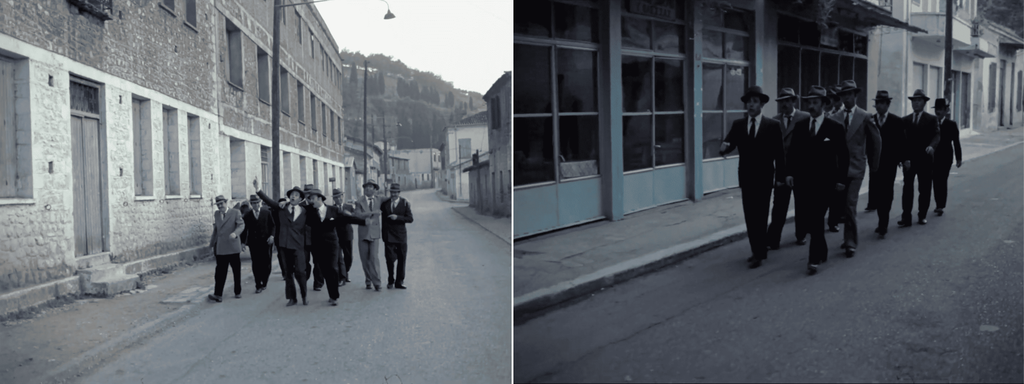
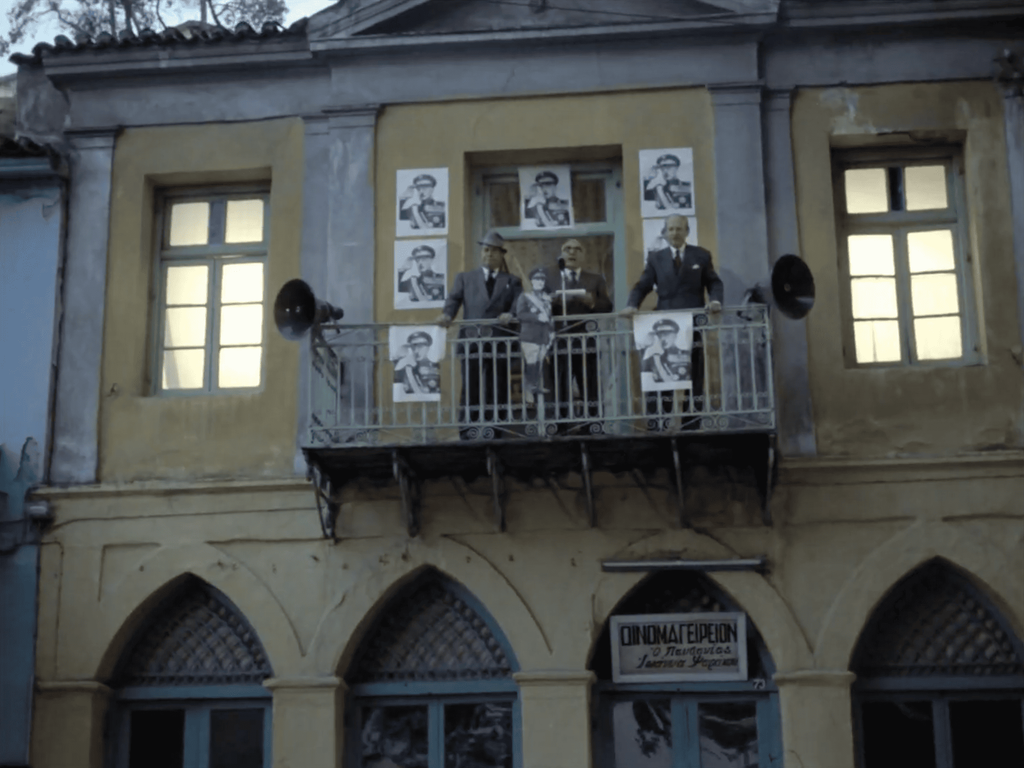
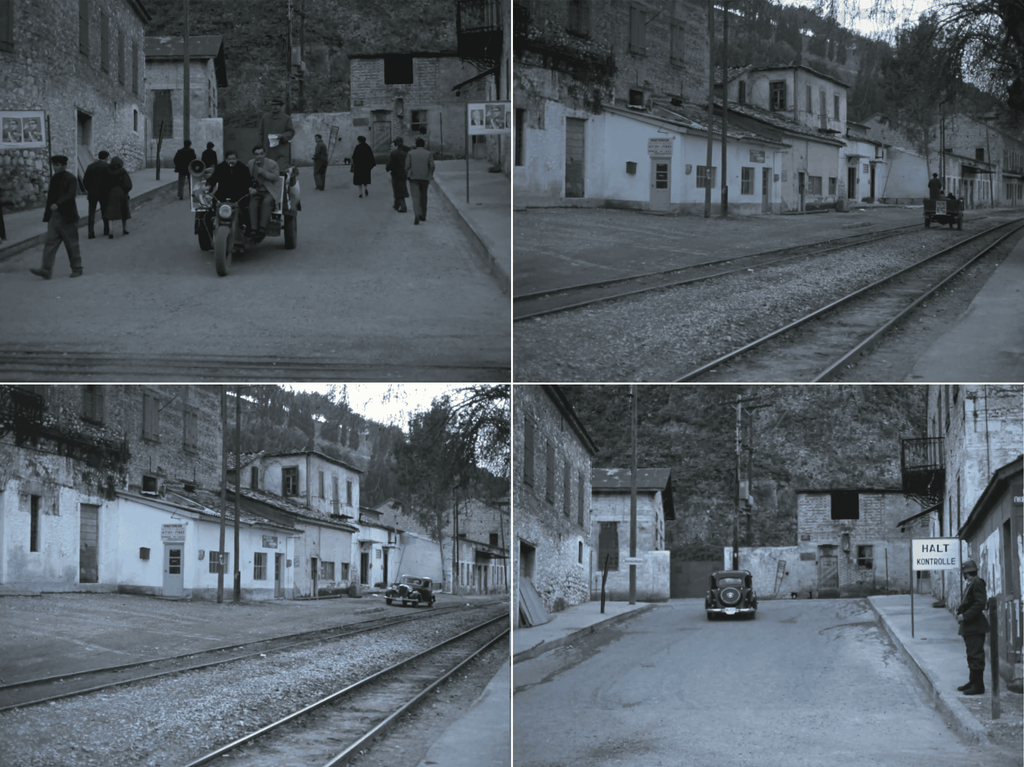
Time is indeed a loose concept in The Travelling Players, though where montages might conventionally bridge the distance between two eras, Angelopoulos allows them to occupy the same space. There is no room here for the aggressive editing of Sergei Eisenstein, carving history into neat chapters that reinforce state propaganda. Instead, long takes conjure a swirling, ceaseless nightmare, exposing those political cycles that have perpetually chained Greece to oppressive powers across decades. A shot might follow a campaign vehicle blaring Papagos’ name through streets festooned with election posters, yet as the camera pans back to the original frame, we now find the same street guarded by a Nazi officer and threatening German signs. Time itself undulates with the camera’s rhythmic, lateral sweep, and for the people of Greece, it offers no respite from constant cultural upheaval.
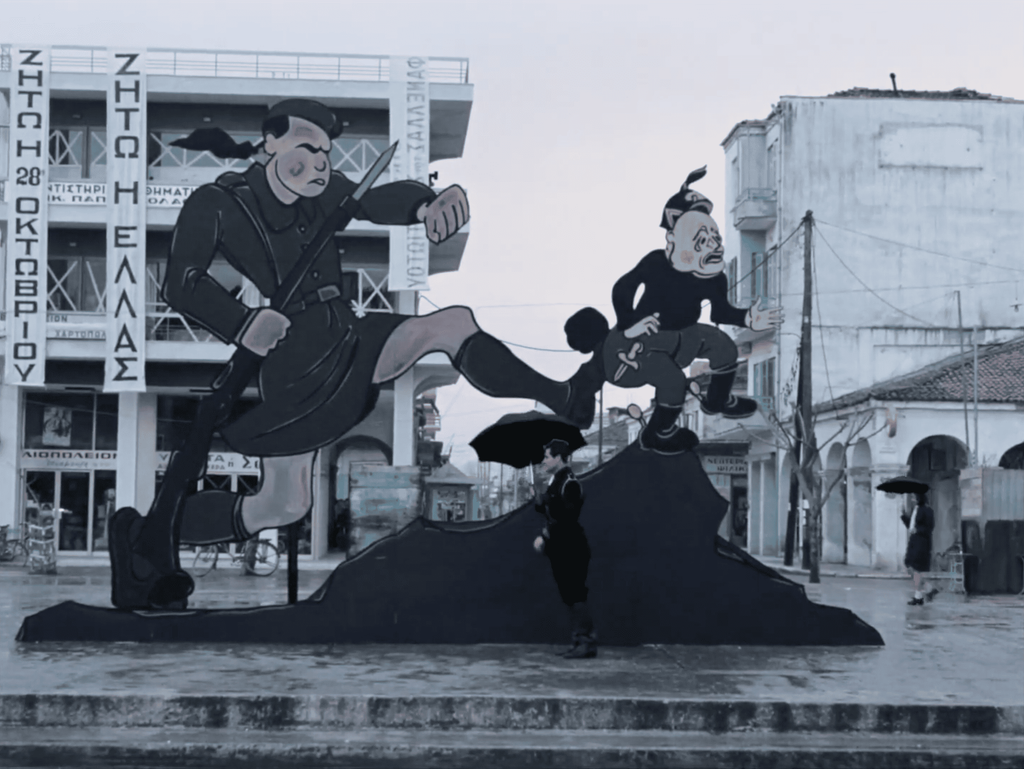
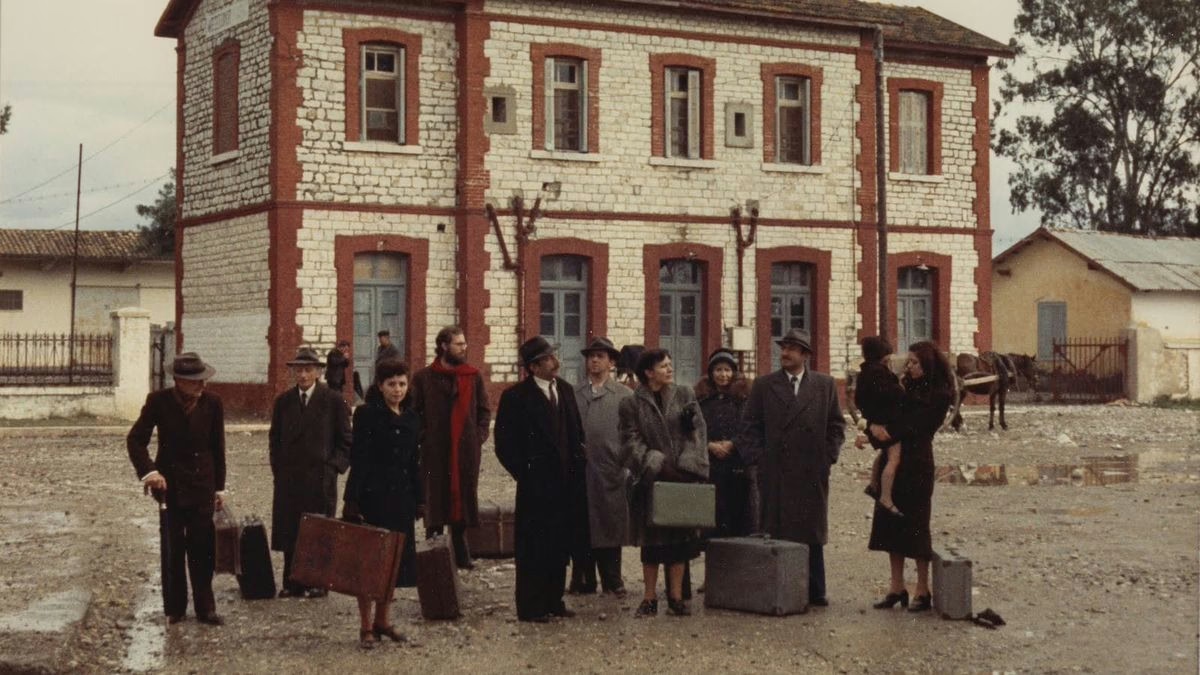
The acting troupe that wanders between towns and stages makeshift productions of Golfo the Shepherdess understands this instability too well. They are the travelling players of the film’s title, and are fractured by clashing political loyalties and betrayals within their own ranks. Against the shattered landscapes of mid-century Greece, they are a densely populated microcosm of society caught between competing powers – though even more importantly, they are also mythic icons transposed upon modern struggle. To navigate the strict political oversight of 1975 after all, Angelopoulos pitched his film as an adaptation of the ancient Greek tragedy The Oresteia set during the 1940s. This conceit was not exactly false, yet by framing these lowly, itinerant actors as the rightful inheritors of high culture, he also turns mythology against the very powers which entrenched the contemporary government’s rule.
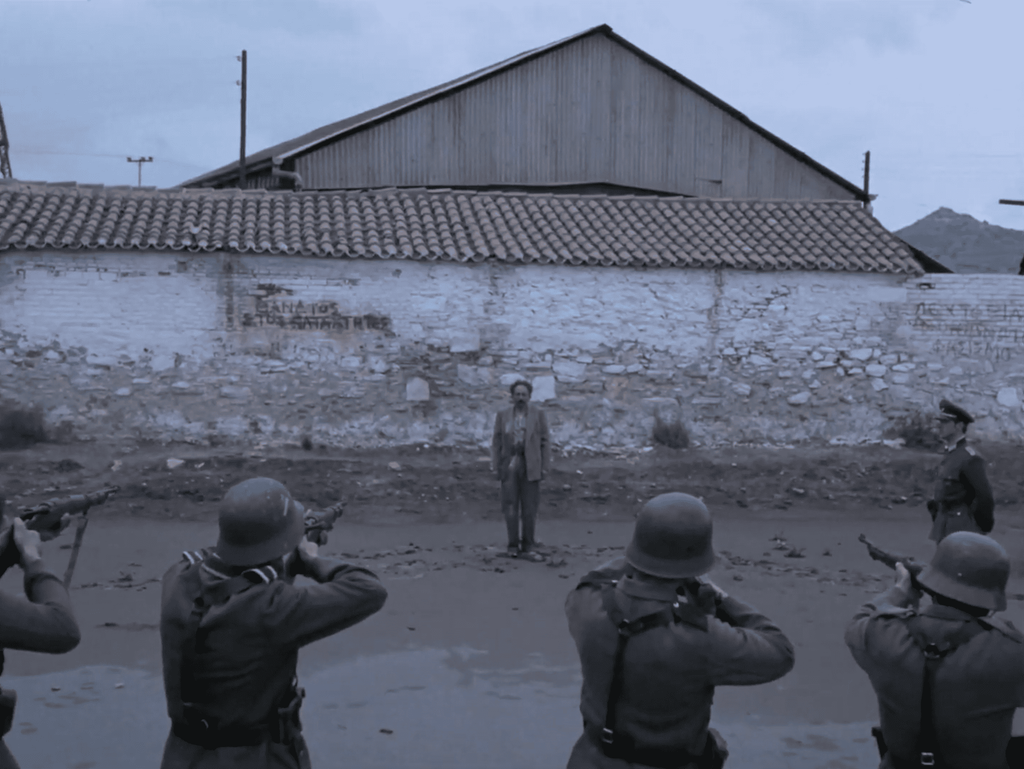
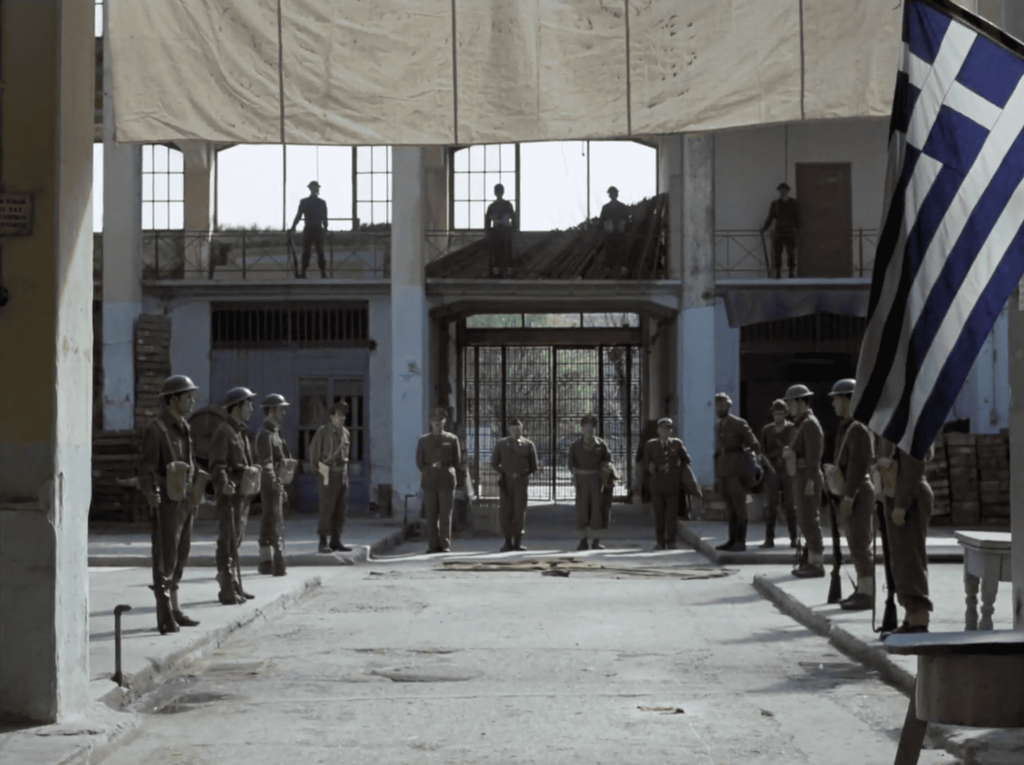
Angelopoulos’ explicit naming of his characters after legendary figures leaves no room for ambiguity either. Far from wielding the historical authority of a glorified king, family patriarch Agamemnon is a refugee from Asia Minor, leading the troupe until he departs in 1940 to fight in the Greco-Italian War. His wife Clytemnestra is not only unfaithful in her affair with the informer Aegisthos, but actively traitorous, betraying her husband to German officials and thereby echoing the murder committed by her mythological counterpoint. Isolating Agamemnon in a prison yard, Angelopoulos’ camera pulls back to reveal a daunting, symmetrical composition of multiple rifles angled toward his diminished figure, and with a sudden volley of gunshots, transforms this fragile troupe’s plight into a matter of existential consequence.
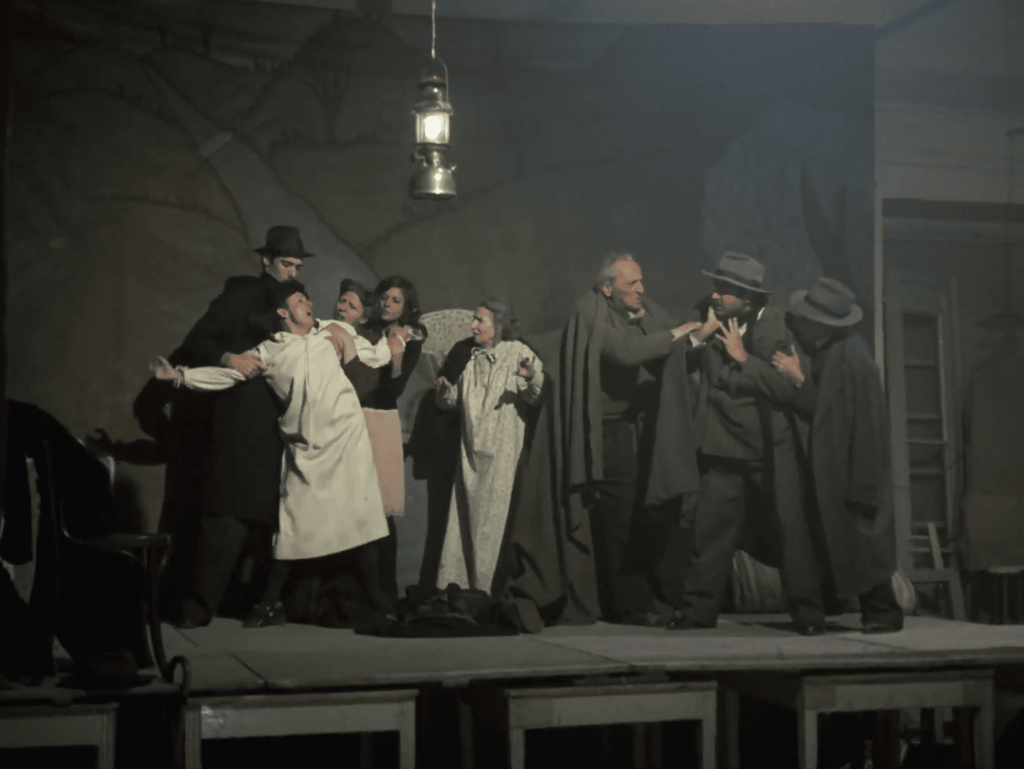
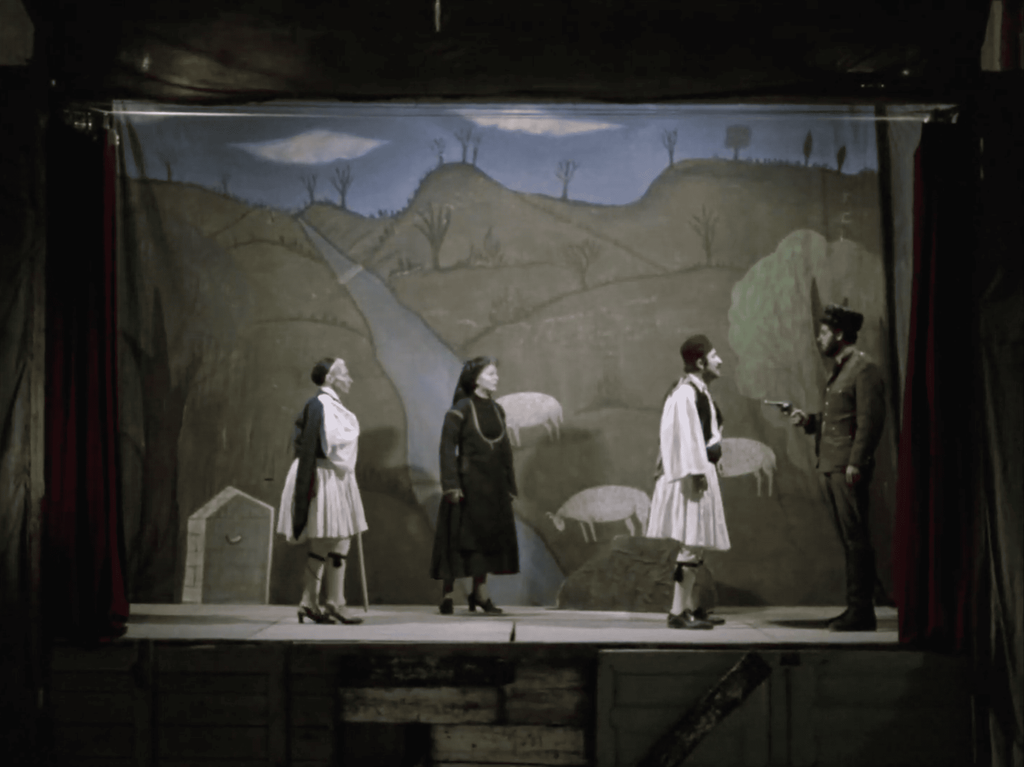
Not that this travelling theatre’s audiences would necessarily grasp the perilous reality behind such merry showmanship. Against crudely painted backdrop of rolling green hills, the actors appear as comic, hapless figures, and the folk melodrama they enact itself presents a highly romanticised vision of pastoral life in Greece. To any conservative government, it is little more than wholesome entertainment – so the fact that Angelopoulos never once lets them finish the play due to inevitable, historical intrusions severely undercuts this fantasy.
In one instance, blaring air raid sirens scatter the cast and audience mid-scene. In another, an improvised performance upon a beach for British liberating forces ends after a soldier is shot dead. When Agamemnon’s son Orestes returns from the Communist-led resistance to avenge his father, the curtains are again prematurely drawn following his onstage murder of Clytemnestra and Aegisthos, thus fulfilling his mythic namesake’s destiny. In every instance, regardless of the actors’ efforts, Golfo the Shepherdess proves to be a fragile fairy tale that simply cannot survive contact with reality.
Through sweeping political turmoil, thorny character drama, and their unstable professional endeavours, Angelopoulos layers his narrative with remarkable formal discipline, and The Travelling Players steadily expands into a work of epic magnitude. Thirteen years in the lives of these actors unfold as a panoramic chronicle, yet on three separate occasions, Angelopoulos also directly breaks the fourth wall to grant them personal testimony.
Agamemnon is the first to offer up a soliloquy, recounting his harrowing flight from Asia Minor in 1922 and his arrival on Greek soil as one of its earliest refugees. He reflects on the mercy of the Italians, the cruelty of the British, and his failure to locate his family, ultimately compelling him to create one of his own in the form of an acting troupe. Considering Pylades’ devastating monologue late in the film though, tragedy is evidently woven into their shared existence. Like his friend Orestes, he is a passionate Communist who risks everything for his ideals, yet his imprisonment leaves deep psychological scars. He cannot even make eye contact with the camera as he talks of the brutal interrogations he suffered on a remote island, instead gazing vacantly out the window, and only turning towards us as he ashamedly confesses to signing a declaration against the Communist Party.
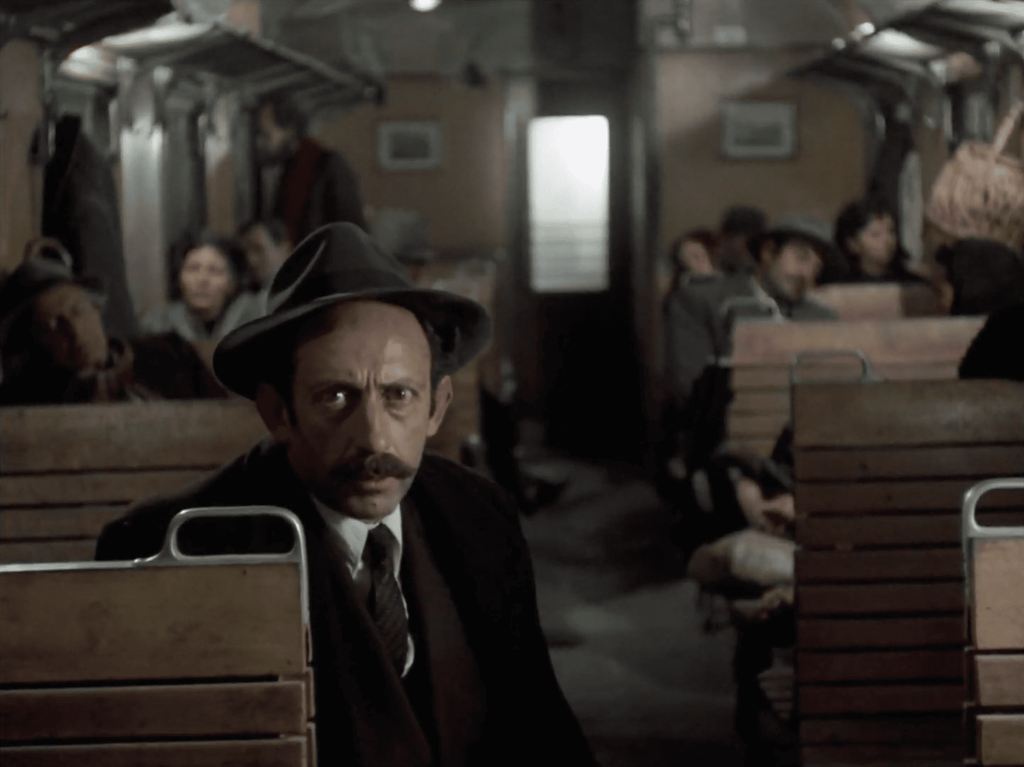
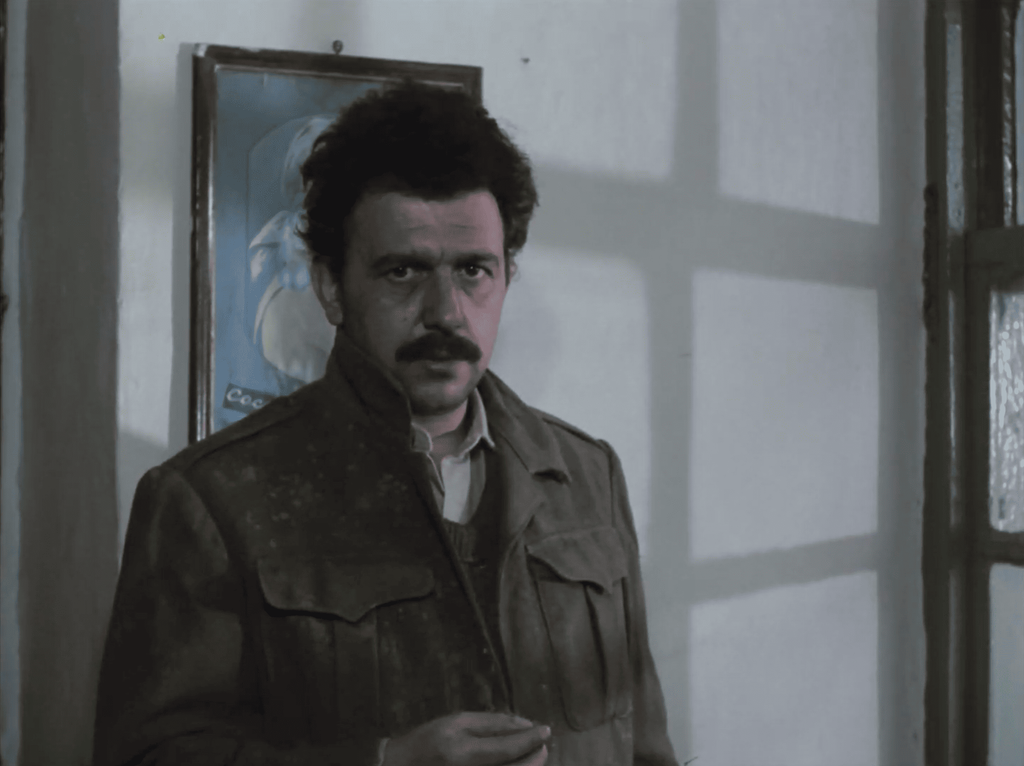
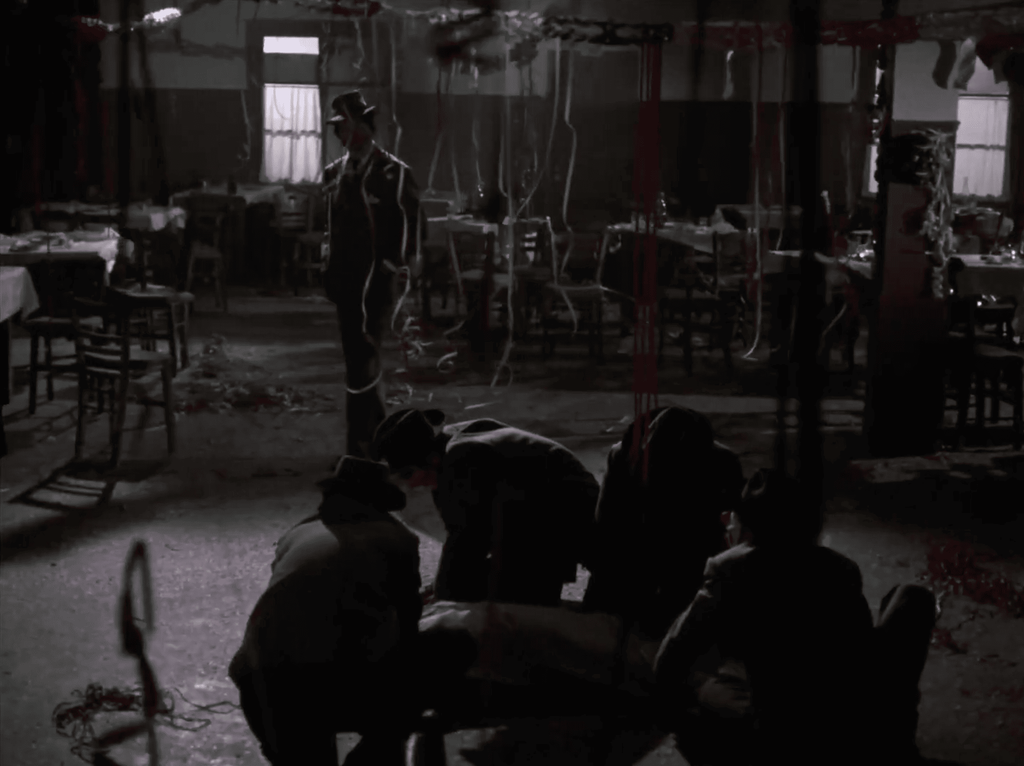
Perhaps the most haunting of these monologues though belongs to Electra, who only addresses the viewer after surviving a harrowing assault. If there is anyone who may be considered the lead in this ensemble piece, it is her, bearing witness to her mother’s affair, her father’s murder, and the ceaseless tides of war that wash up on Greece’s shores. Abducted by men in grotesque clown masks, she is dragged into a party room decorated with hanging streamers, and pinned to the floor. The camera slowly arcs around her attackers as they force themselves on her, demanding Orestes’ whereabouts, before abandoning her by a river. Rather than wallowing in despair however, she stands, brushes herself off, and approaches the camera.
“After the Germans left the country in the fall of 1944, in October, the British, under General Scobie, entered Athens and the first government of National Unity was formed,” she begins, as if delivering a history lecture. From there, she continues to recount her firsthand observation of the Dekemvriana, when disillusioned resistance fighters took to the streets in peaceful protest – and were met with a devastating massacre from their own government. In light of these political betrayals, no longer is her individual suffering contained to personal trauma. With a stark, Brechtian precision, The Travelling Players effectively frames this atrocity as a rape of the people themselves, and exposes the systemic violence keeping them in their place.

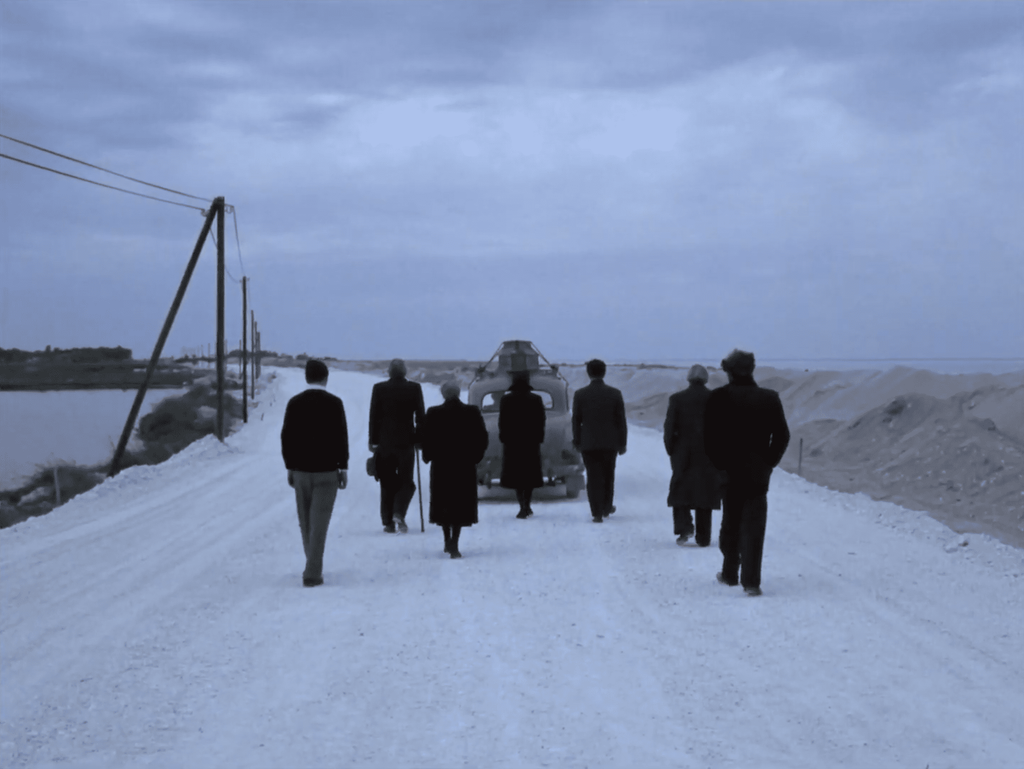
As if adopting a similarly objective perspective, Angelopoulos’s camera also hangs back at a distance from his actors, surveying the muted palettes, desolate landscapes, and war-scarred architecture of mid-century Greece. Paired with his penchant for long takes and dark, deadpan humour, this restrained formalism anticipates the austere rigour of Béla Tarr’s slow-burning cinema, though Angelopoulos’ roots remain firmly in the visceral authenticity of Roberto Rossellini’s war dramas. Heavy, scratchy coats hold off the bitter winter cold as the actors traverse snowy mountain roads and rural villages, though even in the most austere long shots, still they make a slight, warming imprint upon the bleakness with lively songs and buoyant spirits.
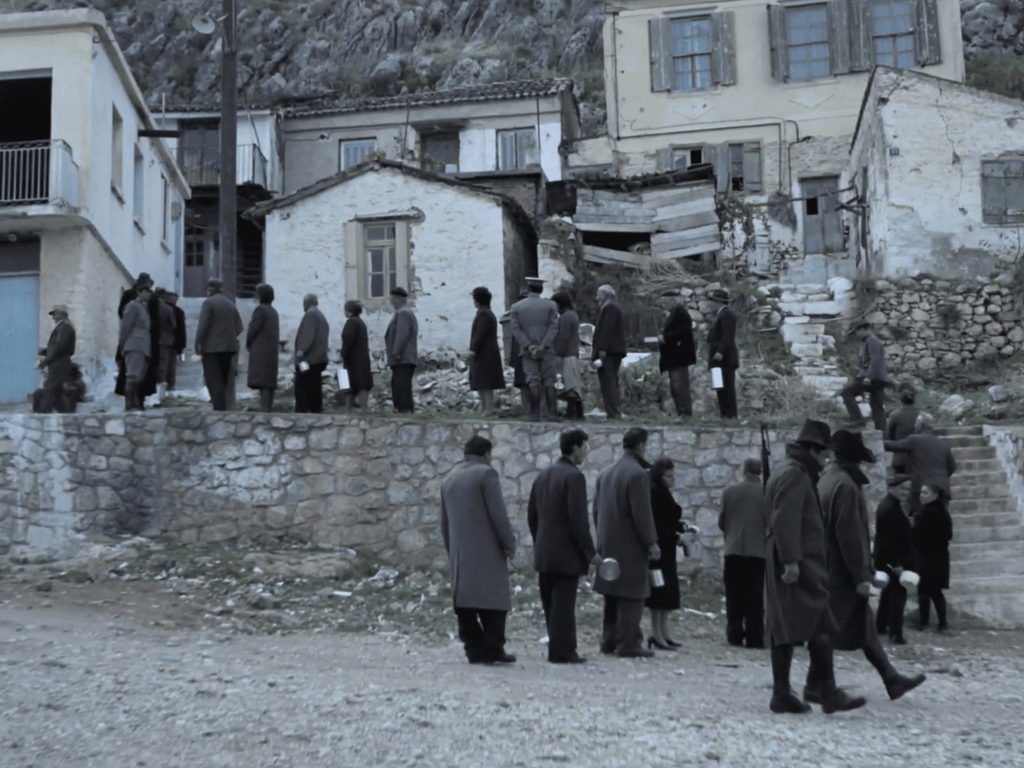
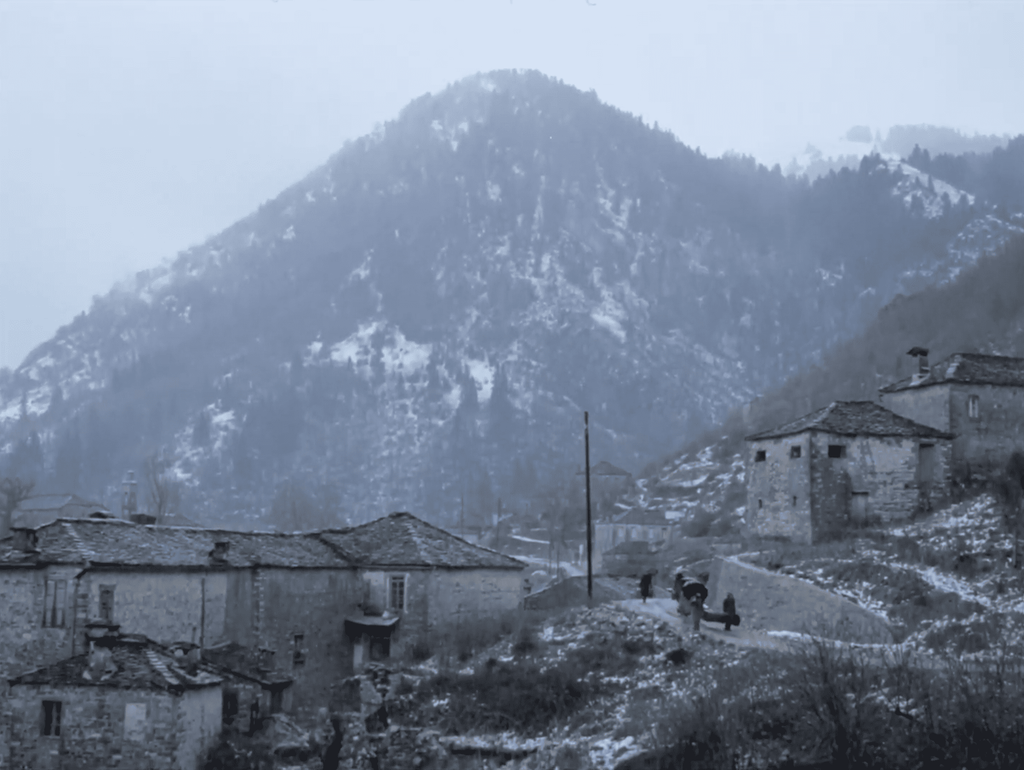
Unfortunately, the onward march of history cares little for such frivolity. Their singing abruptly halts when they stumble upon two bodies hanging from a tree, likely partisans executed by Germans, and they too are inevitably targeted when they are rounded up and imprisoned. It is sheer luck which spares their lives when partisan forces arrive to overthrow the Nazis, yet by this point we are well aware that a change of regime may not be enough to save this nation.
The Communists may have defended Greece in World War II, yet it is not in the best interest of the British to support their ongoing influence, especially with the Soviet Union rising in the East. Even beyond the Nazi occupation, the notion of Greece as a crypto-colonial project is Angelopoulos’ biggest target in The Travelling Players, whereby foreign powers indirectly impose their strategic will upon subordinate nations to keep them compliant.
It’s not just the domestic elite who are the biggest traitors to their own people either. Electra’s sister Chrysotheme is the most apolitical of her family, yet as an opportunist who prostitutes herself to the Germans, sides with the British during liberation, and eventually marries an American, she epitomises betrayal in its coldest, most passive form. For those who remain loyal to their country, witnessing such cynical self-interest becomes unbearable, and this frustration finally erupts in stubborn protest at her wedding when Electra’s son grabs hold of the tablecloth and silently drags it along the shore in another defiantly long take.

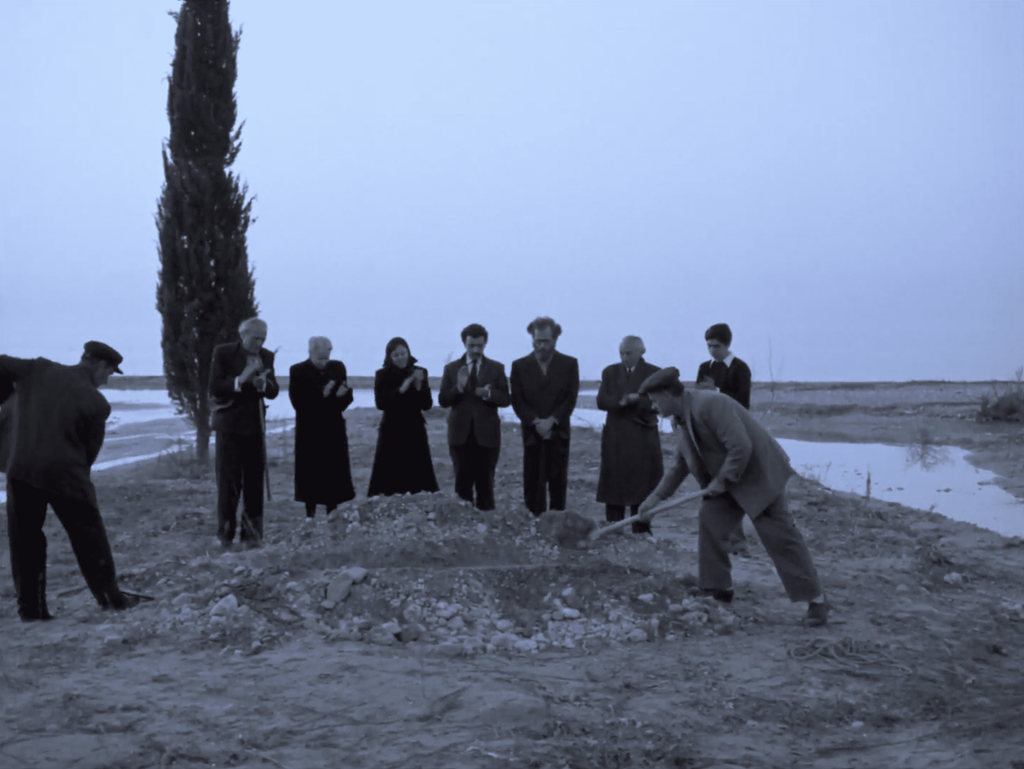
Angelopoulos does not ask us to mourn those Greek martyrs slain by the treachery of their own family though. Finally captured and executed by authorities in 1951, Orestes is buried amid a rural, barren landscape, yet Electra is sure to lead his funeral with applause rather than tears. In this world of endless upheaval after all, identity and trauma are mediated through the inherited cultural belief in archetypal roles, handed down through generations like well-worn costumes.
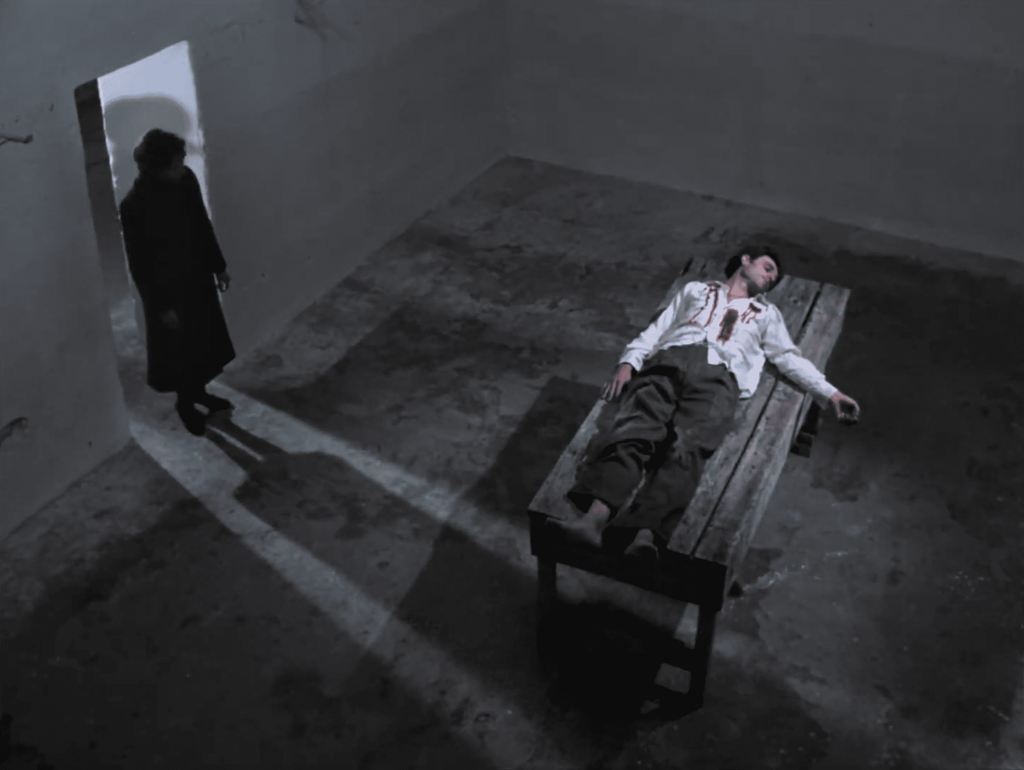
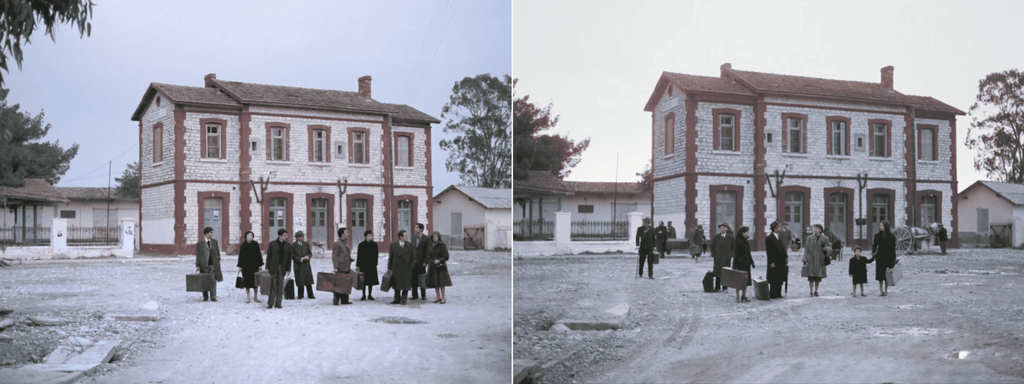
“In the fall of 1939 we returned to Aegion,” Agamemnon’s voiceover reflects in the final seconds, mirroring the almost identical shot and narration from the film’s opening – yet a subtle shift has occurred. Where he previously marked the year as 1952, situated at the chronological end of the narrative, we now find ourselves looping back to the beginning of the troupe’s journey. Time and politics continually reset the stage, yet as foreign powers direct this vast, imperial pageant from the wings, The Travelling Players recognises that no curtain may fall on a history condemned to perpetual reprise.
The Travelling Players is not currently streaming in Australia.
Have a film you’d like me to write about next? Request a review here.
Thank you so much for this review! I’m glad you’ve covered it in such detail, from the long takes dissolving into time and such a thoughtful and in depth analysis on Greece’s political turmoil its very evident you’ve read upon it and the mythical influence of Greek’s Orestaia, I too thought electra was by far the most harrowing character in the film, her monologue just felt so hopeless and dark. I wonder what did you think of the scene in which she walked into the bar club with the lingering tracking shot that lasted 10 minutes? It’s one of my favourite scenes, very happy with how you touched upon the composition too! Such wonderous uses of negative space and a great geometrical unity, the shot where they followed the car reminded me so much of Mishima lol
Fantastic scene, if I recall correctly there wasn’t a word of dialogue spoken but instead you get so much tension in the battle of singing between the left and right factions. And of course you get that display of right-wing power as they end up evicting everyone else from the bar. Probably the best depiction of how exactly they took control socially and then leveraged that to a larger political scale.